
What Is On-Site Nitrogen Generation? A Beginner's Guide to PSA Systems
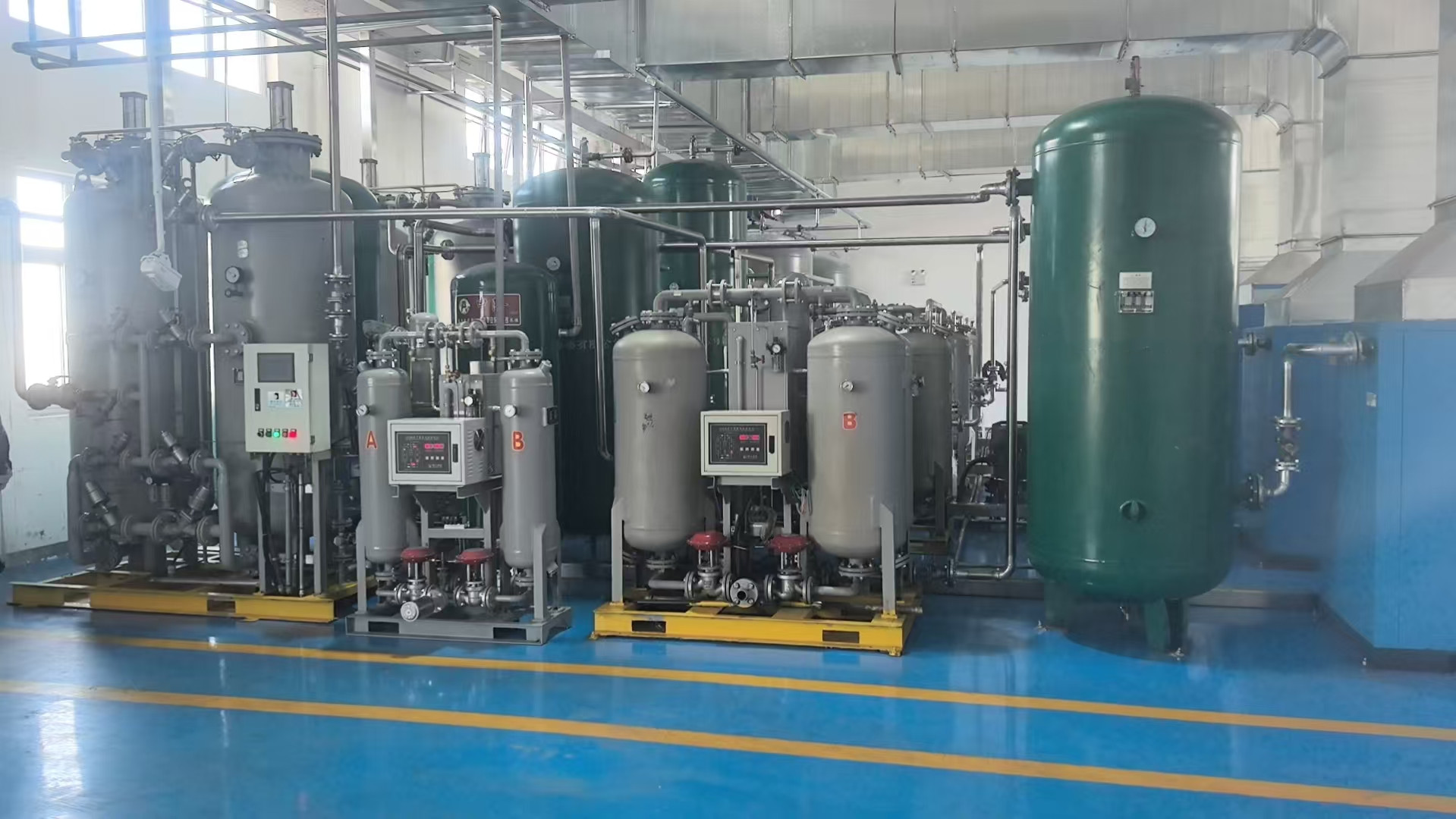
On-site nitrogen generation means producing the nitrogen your process needs at your own plant, from compressed air, instead of buying nitrogen delivered as cylinders or liquid. The method most industrial plants choose for this is PSA — pressure swing adsorption — in which pre-treated compressed air passes through a vessel filled with carbon molecular sieve, a material that adsorbs oxygen, carbon dioxide and moisture while nitrogen passes through as the product gas.
This guide is written for the first-time buyer: a procurement engineer, plant manager or technical decision-maker who knows roughly what purity and flow the process needs, but has no strong opinion yet about how the system should be built. It explains what PSA is, why the generator alone is never the whole system, what each upstream component does, and which specifications, certifications and commercial terms you should be able to read before you talk to a supplier.
Nothing here replaces a project-specific engineering calculation. It is, however, enough to help you ask better questions.
What "On-Site Nitrogen Generation" Actually Means
A PSA nitrogen generator is an on-site gas production unit that extracts nitrogen directly from compressed air. It is not a storage device and it is not a delivery arrangement. It is a compact separation plant that runs on compressed air and electricity and delivers nitrogen at the purity, flow and pressure your process specifies.
Three practical consequences follow from that definition:
- Purity becomes a setting rather than a grade. PSA systems using carbon molecular sieve (CMS) can produce nitrogen with a purity rating of up to 99.999%, and purity is adjustable within the design range of the unit.
- Supply becomes on demand. Flow rate is adjustable, and there is no cylinder handling, dewar changeover or liquid-nitrogen delivery scheduling to manage.
- Cost shifts from logistics to power. Third-party research reports that on-site nitrogen generation can reduce nitrogen supply costs by up to 40% compared with traditional cylinder deliveries, mainly by removing logistics fees.
Beginner's summary: if you consume nitrogen continuously at a purity and flow you can define, and you have floor or skid space for the equipment, on-site PSA generation is normally the configuration to evaluate first.
Industry Background: Where PSA Sits in the Nitrogen Market
PSA is not a niche method. According to Fortune Business Insights, pressure swing adsorption technology accounts for approximately 48% of the global nitrogen generator market share, the largest technology segment. Verified Market Research values the global industrial nitrogen generator market at USD 4.29 billion in 2023, projected to reach USD 6.47 billion by 2031.
Two patterns in that data are relevant when you size a system:
- Most installations are small and mid-size. PSA installations divide by capacity into sub-100 Nm³/h (42%), 100–500 Nm³/h (36%) and above 500 Nm³/h (22%). A buyer who assumes their plant is too small for on-site generation usually sits in the largest single group.
- Purity requirement decides the technology. Membrane nitrogen generators use hollow-fibre modules and typically cover a purity range of 95% to 99.9%. PSA is generally preferred where the process needs more than 99.9% purity.
Asia-Pacific is the fastest-growing region for PSA nitrogen generators, projected to hold a 35% market share by 2032. Key global players include Linde plc, Air Liquide, Air Products, Atlas Copco and Parker Hannifin, alongside regional manufacturers such as Hangzhou Boda Purity Equipment Co., Ltd. (BODA GAS), a PSA nitrogen and oxygen generator manufacturer founded in 2002 and based in Hangzhou, Zhejiang Province, China.
Problem Definition: Your Nitrogen Is Simple — Your Nitrogen Supply Is Not
Nitrogen is colourless, odourless, non-flammable and makes up about 78% of air. The difficulty is rarely the gas itself. It is the supply chain built around it.
Delivered nitrogen introduces constraints that have nothing to do with your process:
- Delivery dependency. Production continuity depends on a supplier's schedule, road conditions and cylinder or tanker availability.
- Handling and storage. Cylinders and dewars require movement, secure storage and changeover routines; liquid nitrogen adds boil-off management to the routine.
- Purity fixed by grade. You buy a specification rather than a setting, and changing purity usually means changing what you order.
- A cost structure you cannot optimise. Gas cost, rental, delivery fees and handling labour all sit outside your plant.
On-site PSA generation addresses these constraints directly: purity and flow are configured to the application, gas is produced where it is used, and the operating inputs become compressed air and electricity — two utilities your plant already manages.
How PSA Separation Works, in One Section
Under pressure, nitrogen and oxygen diffuse through carbon molecular sieve at quite different rates. Oxygen molecules are adsorbed in large part by the sieve, while nitrogen molecules concentrate in the gas phase within a short time, which achieves the separation of oxygen and nitrogen.
Inside the generator, four phases repeat continuously:
- Adsorption and pressurization — CMS adsorbs oxygen and other gases under working pressure, and nitrogen flows to the buffer tank.
- Tower switch and nitrogen output — when the online tower approaches saturation, the system automatically switches the air feed to the other tower to sustain continuous output.
- Pressure equalization — pressure is balanced between the online and standby towers before switching, which lowers energy loss and protects the sieve.
- Regeneration (desorption) — the saturated tower depressurizes and vents trapped impurities, regenerating the carbon molecular sieve for the next cycle.
The Six Building Blocks of On-Site PSA Nitrogen Generation
A common beginner mistake is to compare suppliers on the generator alone. The generator is the separation core, but it is fed by everything upstream of it, and its service life depends on how clean and how dry that feed air is. In a complete on-site nitrogen generation package, six blocks work in sequence.
Block 1 — Air Compressor: The Feed-Air Source
The compressor supplies the compressed air that the whole system separates. Its duty must match the nitrogen flow you require, adjusted for the air-to-nitrogen ratio — a value the supplier's engineering team calculates against your site altitude, voltage and industry. Compressor servicing is also a recurring cost item: standard maintenance, including oil, oil filter and air/oil separator changes, is generally scheduled every 3,000 to 4,000 running hours.
Block 2 — Air Receiver and Buffer Tanks
Tanks appear at three points in the system, and each has a different job:
- Wet air buffer tank: stabilises compressed-air pressure, reserves air volume and reduces pressure impact.
- Dry air buffer tank: maintains a stable dry-air supply for the PSA towers against peak-demand pressure drop.
- Nitrogen buffer tank: smooths pressure and flow fluctuation caused by tower switching, and covers peak gas consumption at the point of use.
Block 3 — Dryers: Setting the Dew Point of the System
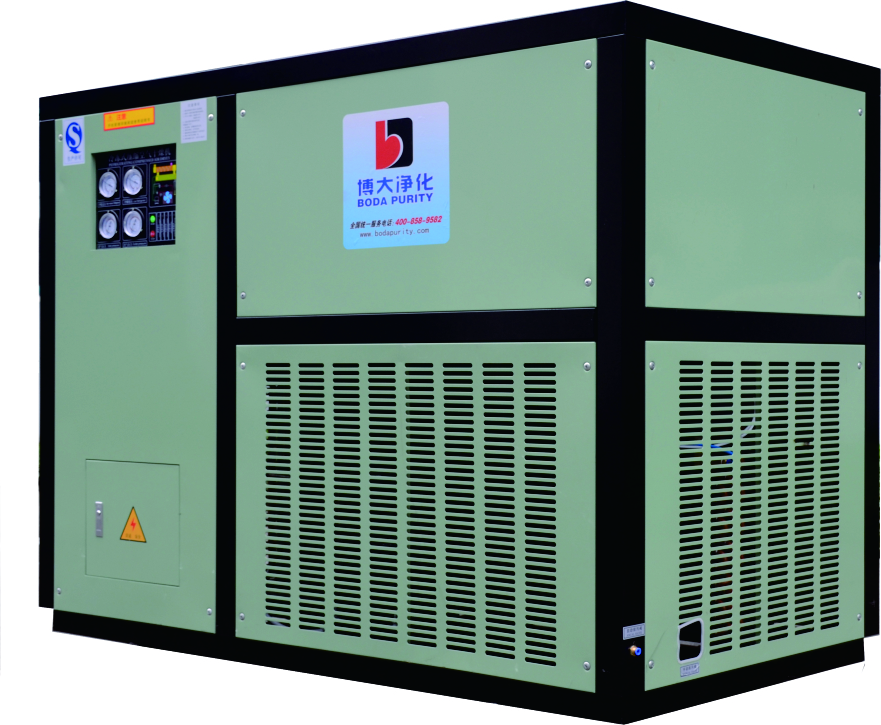
Water is the first thing to remove, because moisture competes with oxygen for adsorption sites on the molecular sieve. Dryers are selected by the dew point your end-use points actually require:
- Refrigeration dryer (FAD Series): air-cooled, water-cooled and high-temperature versions; rated air treatment flow 1–200 Nm³/min; working pressure 0.6–0.8 MPa (0.8–3.0 MPa optional); qualified air dew point ≤-23 °C under ambient pressure; inlet temperature below 38 °C, or below 80 °C for the high-temperature version. Danfoss brand components are the main refrigeration components of the machine.
- Heatless desiccant dryer (ADL Series): 0.5–500 Nm³/min; dew point ≤-40 °C or ≤-52 °C; regeneration air loss ≤12%; pressure loss ≤0.02 MPa; standard operating cycle 10 minutes (modifiable).
- Heated desiccant dryer (ADH Series): 1–500 Nm³/min; dew point ≤-40 °C or ≤-52 °C; regeneration air loss ≤6%, which is roughly half the purge consumption of a heatless unit.
- Combined low dew point dryer (FAG Series): 1–300 Nm³/min; qualified air dew point ≤-60 °C to -70 °C; regeneration air loss 3–6%. It combines a refrigerated dryer and an adsorption dryer in one piece of equipment.
A dryer is needed specifically for high-purity nitrogen, for end-use points with defined water-content (dew point) performance, and for sites with high ambient temperature.
Block 4 — The Filtration Train: Five Devices, Five Different Jobs

Filtration exists to protect the carbon molecular sieve. Oil contamination is described in the equipment documentation as one of the most important failure forms of gas-generator adsorbents, and excess moisture reduces the sieve's adsorption performance. The filtration train typically runs in this order:
- High efficiency oil-water separator (FYS Series): front-end pretreatment that intercepts bulk liquid water and oil droplets using three-stage centrifugal, impact and gravity-settling separation, with gas-liquid separation efficiency above 98%. It uses physical separation with no consumable filter element, which keeps maintenance cost low. Rated flow 1–500 Nm³/min; inlet temperature below 50 °C; pressure loss ≤0.02 MPa.
- High efficiency oil-remover (FLY Series): integrates cyclone separation, coarse filtration and fine filtration; finished compressed-air filtration precision reaches 0.1 μm with residual oil below 0.01 mg/m³.
- Precision filter (FAL Series): second-stage pretreatment using a gradient composite glass-fibre cartridge to trap dust, rust, fine water droplets and oil mist, protecting the downstream oil-remover, activated carbon filter, dryer and PSA generator. Flow 1–500 Nm³/min; pressure loss ≤0.02 MPa; carbon steel or SS304 housing; optional automatic drain valve.
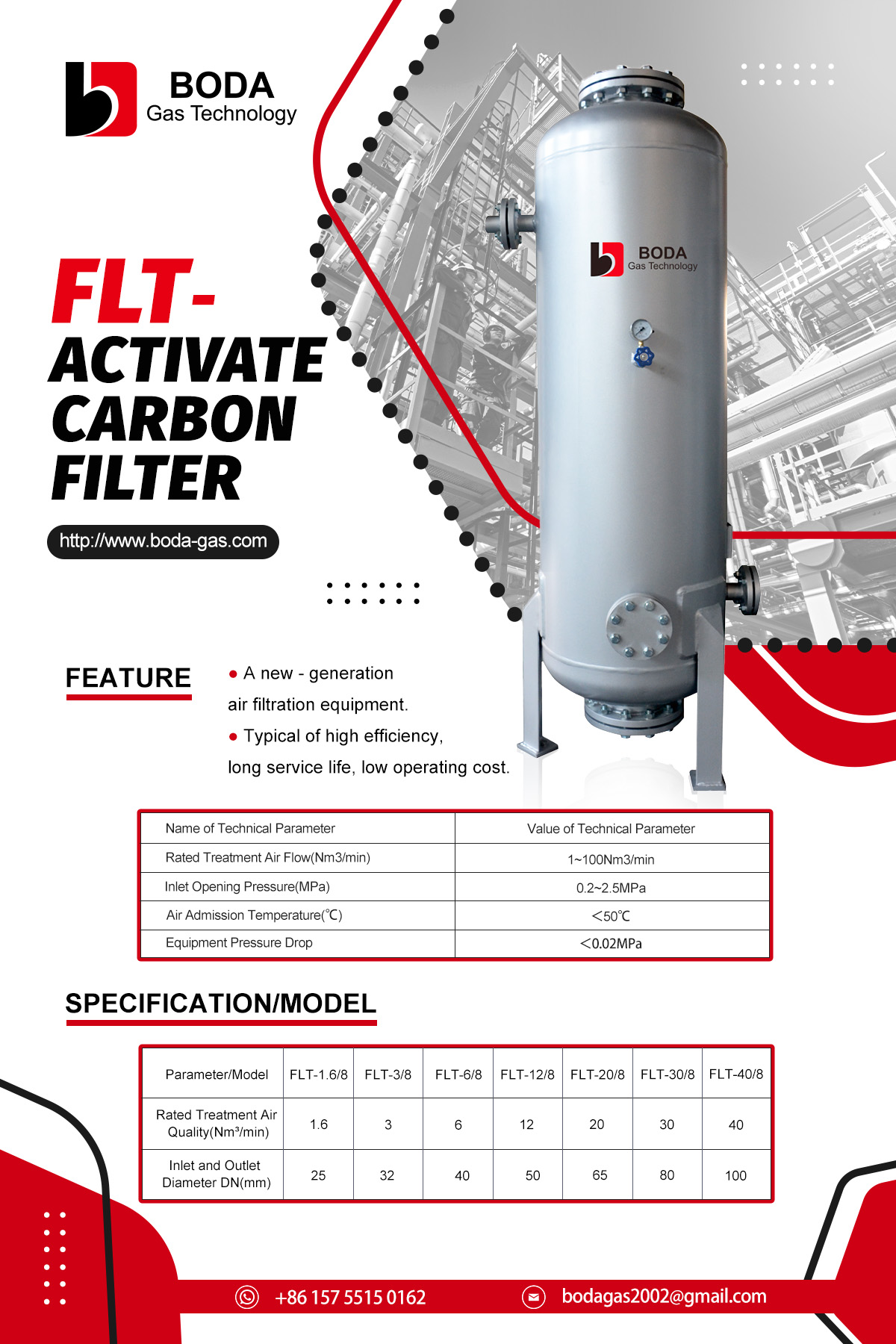
- Activated carbon filter (FLT Series): terminal purification stage filled with high-density column-shaped activated-carbon granules to remove oil vapour and VOC impurities. Outlet residual oil content is below 0.003 mg/m³. An anti-powder-leakage baffle-plate design prevents carbon dust from entering downstream equipment, and multi-layer graded filling avoids air-flow short-circuit.
- Sterilizing filter (FLC Series): used where nitrogen comes into contact with product — aseptic beverage filling, dairy processing, food nitrogen-flush packaging, pharmaceutical and biopharmaceutical gas purification. Filtering accuracy is 0.1 μm; the hydrophobic microporous cartridge operates from 0 to 80 °C and supports 121 °C online steam sterilization for repeated use. Applicable media are air and nitrogen; the housing material is SS304.
Block 5 — The PSA Nitrogen Generator: The Separation Core
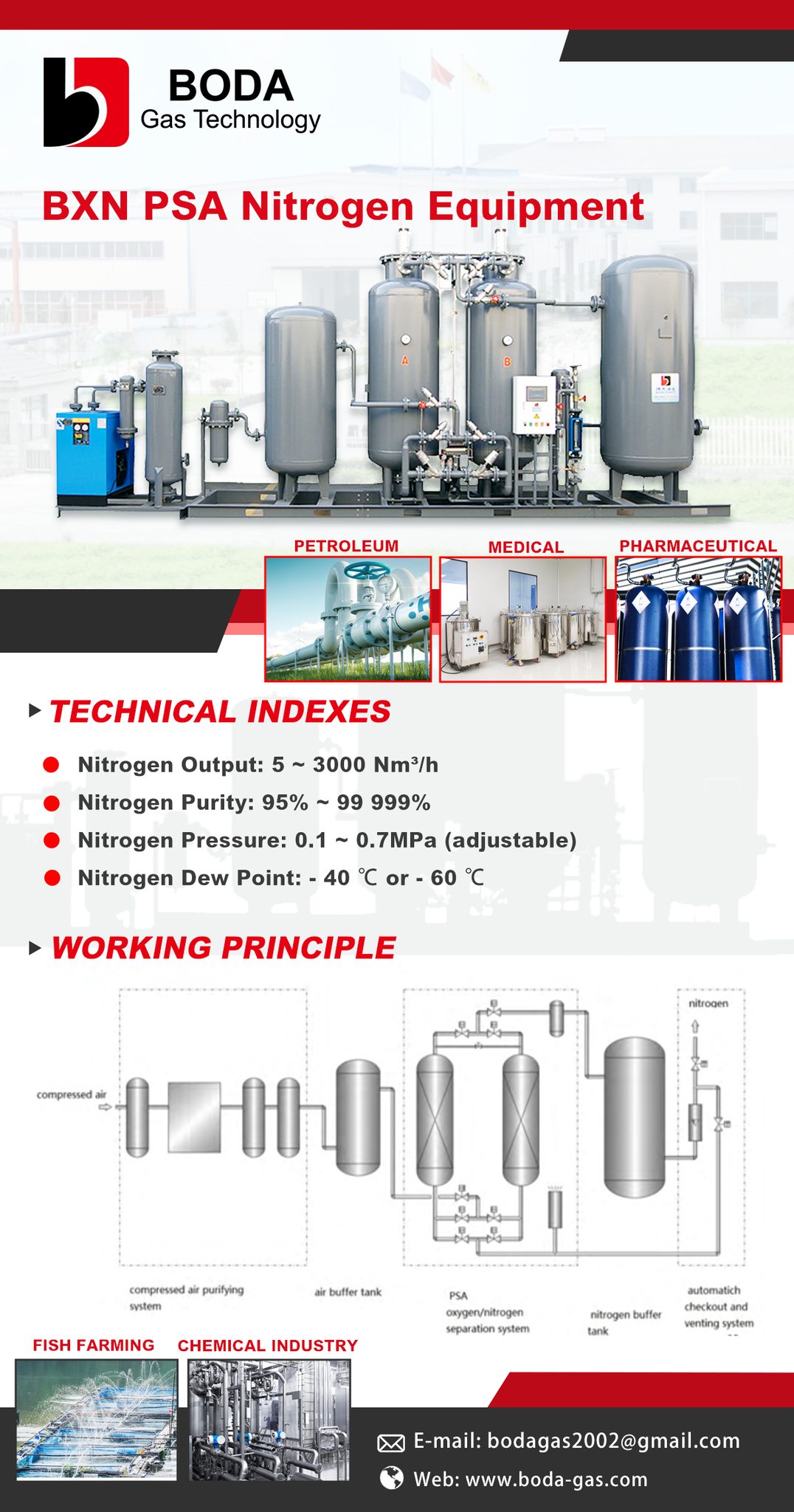
Verified parameters of the BXN Series PSA nitrogen generator:
- Nitrogen flow rate: 1–3000 Nm³/h
- Nitrogen purity: 95%–99.999%
- Nitrogen pressure: 0.1–1.15 MPa (adjustable)
- Nitrogen dew point: -40 °C to -70 °C
- Noise: 65–85 dB(A)
- Material: carbon steel / SS304, with customization to ATEX, ASME, CE and ISO standards
Configuration types include the industrial PSA nitrogen generator, the skid-mounted PSA nitrogen generation package, the movable containerized PSA nitrogen generator, the ASME standard nitrogen generator and the stainless steel nitrogen generator. That distinction matters when the unit has to be transported between sites, installed in a hazardous-area environment, or built in stainless steel for hygiene-sensitive duty.
Block 6 — Buffer Tank, Purity Monitoring and Control
Downstream of the generator, a nitrogen buffer tank stores produced gas to handle peak flow demand. An oxygen analyzer or purity sensor continuously monitors gas purity and automatically vents out-of-specification gas. The control system governs automatic valve actions, purge cycles and overall pressure regulation. Optional features include touch-screen display, dew point detection, energy-saving control and DCS communication.
Step by Step: How Compressed Air Becomes Nitrogen
At system level, the process runs in a fixed sequence:
- Compression. The air compressor supplies compressed air to a receiver tank.
- Bulk liquid removal. The oil-water separator takes out free water and oil droplets.
- Drying. A refrigeration dryer and, where required, an adsorption dryer bring the air to the target dew point.
- Fine filtration. Oil-remover, precision filter and activated carbon filter remove oil mist, particulates and oil vapour in sequence.
- Adsorption. Clean, dry compressed air enters the online adsorption tower; carbon molecular sieve adsorbs oxygen, carbon dioxide and moisture, and nitrogen passes through.
- Tower switching. The controller switches feed air to the second tower before the first saturates, sustaining continuous nitrogen output.
- Regeneration. The saturated tower depressurizes and vents the trapped impurities, restoring the sieve for the next cycle.
- Storage and quality control. Nitrogen enters the buffer tank; the analyzer verifies purity and vents any off-specification gas before it reaches the point of use.
Use Cases: Matching Purity to Application
Purity selection is the decision that most affects both capital cost and energy consumption, because higher purity requires more feed air per unit of nitrogen. Verified operating ranges by industry:
| Industry | Typical nitrogen purity | Typical duty |
|---|---|---|
| Petroleum industry | 95%–99.9% | Tank blanketing, nitrogen purging, pipeline and vessel inerting, well stimulation, pressure-holding and well-bore flushing |
| Chemical industry | 99.0%–99.99% | Reactor inert shielding, raw-material tank blanketing, pipeline purging, powder conveying; explosion-proof and ASME requirements are common |
| Food and beverage packaging | 99.0%–99.9% (food-grade, oil-free) | Modified atmosphere packaging, beverage production and tank blanketing, freshness keeping |
| Pharmaceutical industry | 99.99%–99.999% | Drug production, storage, sealing and packaging; oil-free air supply and stainless steel construction |
| Electronics industry | 99.99% for common SMT workshops; 99.999%–99.9999% with dew point ≤-60 °C for chip and wafer work | Semiconductor fabrication and packaging, component processing, LED and LCD production, lithium-battery manufacturing |
| Laser and plasma cutting | 95%–99% for ordinary carbon steel; 99.99%–99.999% for mirror-finish stainless steel | High-pressure nitrogen as auxiliary cutting gas; a nitrogen booster is matched for high-pressure output |
| Tyre inflation | 95%–98% | Automobile-service, fleet, engineering-vehicle and bus tyre nitrogen inflation |
For first-pass selection, these purity bands are commonly used: 95–98% (low purity) for fire protection, marine tank blanketing, oil-field pipeline purging and general tyre inflation; 99–99.9% (medium purity) for food and beverage modified atmosphere packaging, winemaking and conventional plastic moulding; 99.95–99.99% (high purity) for mild-steel laser cutting, electronics manufacturing, cable production and pharmaceutical tank blanketing; and 99.999% and above (ultra-high purity) for cutting special metals such as titanium alloy, high-end electronics production and specialised laboratory applications.
Comparison Table: PSA System Components at a Glance
Every figure in the table below comes from published equipment parameters for the series named. Units are stated as published: treatment equipment is rated in Nm³/min, while generator output is rated in Nm³/h.
| Stage | Series | Function in the PSA system | Verified parameters | Material / options |
|---|---|---|---|---|
| Refrigeration dryer | FAD | Bulk moisture removal | 1–200 Nm³/min; dew point ≤-23 °C; pressure loss ≤0.02 MPa | Carbon steel / SS304; stainless steel, ATEX, ASME, CE |
| Heatless desiccant dryer | ADL | Deep drying without heater | 0.5–500 Nm³/min; dew point ≤-40 °C or ≤-52 °C; regeneration air loss ≤12% | Carbon steel / SS304; stainless steel, ATEX, ASME, CE |
| Heated desiccant dryer | ADH | Deep drying with lower purge loss | 1–500 Nm³/min; dew point ≤-40 °C or ≤-52 °C; regeneration air loss ≤6% | Carbon steel / SS304; stainless steel, ATEX, ASME, CE |
| Combined low dew point dryer | FAG | Very low dew point in one unit | 1–300 Nm³/min; dew point ≤-60 °C to -70 °C; regeneration air loss 3–6% | Carbon steel / SS304; air or water cooling |
| Oil-water separator | FYS | Bulk liquid water and oil removal | 1–500 Nm³/min; separation efficiency >98%; no consumable element | Carbon steel / SS304 |
| Oil-remover | FLY | Oil mist removal | Residual oil <0.01 mg/m³; filtration precision 0.1 μm | Carbon steel / SS304 |
| Precision filter | FAL | Particulate protection for the sieve | 1–500 Nm³/min; pressure loss ≤0.02 MPa | Carbon steel / SS304 |
| Activated carbon filter | FLT | Oil vapour and VOC removal | Residual oil <0.003 mg/m³; pressure loss ≤0.02 MPa | Carbon steel / SS304 |
| Sterilizing filter | FLC | Sterile-grade filtration for product contact | 0.1 μm accuracy; 0–80 °C; 121 °C steam sterilization | SS304; media: air and nitrogen |
| PSA nitrogen generator | BXN | Oxygen/nitrogen separation | 1–3000 Nm³/h; purity 95%–99.999%; pressure 0.1–1.15 MPa; dew point -40 °C to -70 °C | Carbon steel / SS304; ATEX, ASME, CE, ISO |
Where high purity is the governing constraint, the technology comparison is straightforward. PSA using carbon molecular sieve reaches up to 99.999% purity (BXN Series range: 95%–99.999%). Membrane separation reaches 95%–99.9% (BMN Series) with a simple structure and no moving parts in the separation stage, which is why it is often chosen for compact, low-maintenance installations within that purity band. PSA is generally preferred above 99.9%.
Compliance and Certification: What to Ask Before You Order
For a system that produces a process gas, certification is not paperwork. It tells you which markets, materials and inspection regimes the equipment was actually built against.
BODA GAS holds management-system certifications issued by YAB CERTIFICATION CO.,LTD. and applicable globally: ISO 9001:2015 quality management (certificate number 244-25-QL-11075-R0-S, issue date 2025-08-11, expiry 2028-08-10); ISO 14001:2015 environmental management (certificate number 244-24-EJ-09517-R2-S); and ISO 45001:2018 occupational health and safety management (certificate number 244-24-SY-09318-R2-S). The certified scope covers relevant management activities in the production of BXN PSA nitrogen equipment, BXO PSA oxygen equipment, general refrigeration compressed air dryer and general adsorption compressed air dryer.
Project-level compliance depends on destination and site classification:
- EU: pressure vessels in PSA nitrogen generators must comply with the Pressure Equipment Directive (PED 2014/68/EU) and bear the CE mark.
- Hazardous areas: oil and gas installations frequently specify an explosion-proof PSA nitrogen generator for Zone 1 / Zone 2 hazardous-gas working areas, which corresponds to ATEX requirements in many projects.
- Pressure vessel standards: ASME is commonly requested for oil, gas and chemical projects; BXN Series units are available in an ASME standard configuration.
- Food-grade nitrogen: EIGA standards require at least one continuously online residual oxygen analyzer in the nitrogen gas stream.
Customization options recorded for BXN Series equipment include carbon steel or stainless steel construction and compliance with ATEX, ASME, CE and ISO standards, plus optional touch-screen display, dew point detection, energy-saving control and DCS communication.
What Drives Cost, and What Maintenance Actually Looks Like
Because configuration drives price, no supplier can quote responsibly from a purity number alone. The variables that move cost are flow rate, purity, outlet pressure, required dew point, housing material (carbon steel versus SS304), certification scope (ATEX, ASME, CE) and configuration type (skid-mounted package or movable container). Two systems with identical purity can differ substantially if one must be explosion-proof and the other does not.
On the operating side, the maintenance rhythm is predictable and itemised:
- Precision filter element replacement: every 8,000 running hours
- Air compressor service, including oil, oil filter and air/oil separator changes: every 3,000 to 4,000 runtime hours
- Air dryer desiccant replacement: generally 16,000 to 24,000 hours
- Carbon molecular sieve replacement: typically 6 to 10 years
BODA GAS builds these systems at a 30,000 m² production base in Hangzhou, Zhejiang Province, with a monthly capacity of 40 units, an annual output of 480 units, 58 employees and a 15-engineer R&D team. Equipment is supplied under an OEM and ODM model with a minimum order quantity of 1 unit, and every unit receives 100% testing — visual inspection plus function inspection — before factory release. After-sales support includes on-site and remote installation guidance, operation-staff training and remote technical support, with a 12-month equipment guarantee.
FAQ: On-Site PSA Nitrogen Generation for First-Time Buyers
1. What certifications should accompany a PSA nitrogen generator before it ships to my site?
Start with the manufacturer's management-system certificates and check that their certified scope actually covers the equipment you are buying. BODA GAS holds ISO 9001:2015 quality management (certificate 244-25-QL-11075-R0-S, valid 2025-08-11 to 2028-08-10), ISO 14001:2015 environmental management (244-24-EJ-09517-R2-S) and ISO 45001:2018 occupational health and safety management (244-24-SY-09318-R2-S), all issued by YAB CERTIFICATION CO.,LTD. and applicable globally, with scope covering the production of BXN PSA nitrogen equipment, BXO PSA oxygen equipment, general refrigeration compressed air dryer and general adsorption compressed air dryer. Then add the project-level requirements that apply to your destination: PED 2014/68/EU and CE marking for EU pressure vessels; explosion-proof construction for Zone 1 / Zone 2 hazardous areas in oil and gas; ASME where the market or project specification requires it. For food-grade nitrogen, the EIGA requirement for at least one continuously online residual oxygen analyzer in the gas stream should be reflected in the system design.
2. Can one PSA system be configured for both my required purity and my required flow?
Yes, within a defined design range — but purity and flow must be specified together, because higher purity requires more feed air per unit of nitrogen. The BXN Series PSA nitrogen generator covers a nitrogen flow rate of 1–3000 Nm³/h, a purity range of 95%–99.999%, an adjustable outlet pressure of 0.1–1.15 MPa and a nitrogen dew point of -40 °C to -70 °C, at a noise level of 65–85 dB(A). The same range is available in several build types: industrial PSA nitrogen generator, skid-mounted PSA nitrogen generation package, movable containerized PSA nitrogen generator, ASME standard nitrogen generator and stainless steel nitrogen generator. Housing can be carbon steel or SS304, and units can be customized to ATEX, ASME, CE and ISO standards.
3. What determines the cost of an on-site nitrogen generation system, and what will maintenance cost over time?
Capital cost is driven by flow rate, purity, outlet pressure, dew point requirement, material (carbon steel versus SS304), certification scope (ATEX, ASME, CE) and configuration (skid-mounted or containerized). Operating cost is driven by power consumption, which rises with purity, plus consumables. The consumable schedule is predictable: precision filter elements are typically replaced every 8,000 running hours; compressor service including oil, oil filter and air/oil separator changes every 3,000 to 4,000 runtime hours; air dryer desiccant generally every 16,000 to 24,000 hours; and carbon molecular sieve typically every 6 to 10 years. Because configuration varies with every project, BODA GAS does not quote from a list: the technical team calculates the air-to-nitrogen ratio, outlet flow, purity and power consumption against your site altitude, voltage and industry, then draws an exclusive layout and technical scheme at no charge.
4. How can I validate a system design before committing to a full production order?
Validation starts with the technical scheme: the air-to-nitrogen ratio, outlet flow, purity and power-consumption calculation is prepared against your own working conditions, so you can check the design against your process before any hardware is committed. Commercially, the minimum order quantity is 1 unit, which allows a single-unit configuration to be ordered for evaluation rather than a volume commitment. Every unit is 100% tested — visual inspection plus function inspection — before factory release, and the equipment is skid-mounted and plug-and-play: it is positioned on site and started after power connection, with no complex installation scope. Remote start-stop, dew-point readout and remote-control functions can be included as customization options where you need to verify performance from a distance. If you want to review a configuration for your plant, the fastest route is to send your nitrogen flow rate, purity, discharge pressure, voltage/frequency and application to the BODA GAS technical team for a free scheme and quotation.
5. What is the typical lead time and production capacity behind an order?
Standard lead time is 25–45 days, supported by a monthly production capacity of 40 units at the 30,000 m² Hangzhou facility, which produces 480 units per year with 58 employees and a 15-engineer R&D team. The minimum order quantity is 1 unit, and units can be customized for flow rate, purity, pressure, dew point, material, production standard, voltage, logo, nameplate and painting colour. To start a project, contact the team directly by email at bodagas2002@gmail.com, by phone or WhatsApp at +86 157-5515-0162, or through boda-gas.com, and request a configuration scheme for your nitrogen flow, purity and site conditions.
Conclusion: Start With the System, Not the Generator
On-site nitrogen generation is best understood as a small gas plant rather than a single machine. The PSA generator performs the separation, but the compressor, receiver tanks, dryers, filtration train, buffer tank and purity monitoring determine whether that separation stays stable over years of operation. A buyer who reads a quotation as a system — and asks for the dew point, filtration accuracies and certification scope behind each line — will make a better decision than one who compares generator prices alone.
For a first project, work through the following in order: define purity and flow from the application; decide the dew point the end-use points actually need; confirm the certification regime your market requires; confirm the capacity and lead time a supplier can commit to; and check the maintenance intervals against your own service capability. Answer those five questions and the technical conversation becomes short.
Next Step: Get a Configuration Scheme for Your Nitrogen Requirement
Send your nitrogen flow rate, purity, discharge pressure, voltage and application, and the BODA GAS engineering team will prepare a layout and technical scheme for your working conditions.
Email: bodagas2002@gmail.com | Tel / WhatsApp: +86 157-5515-0162 | Web: www.boda-gas.com
Download the full product manual: BODA GAS TECH Product Manual (PDF)

Have Questions or Need More Details?
Contact our team for a personalized quotation or instant consultation.
Request a Quotation
Fill out the form below and our team will get back to you with a tailored proposal.
WhatsApp Direct Chat
Prefer to chat in real-time? Message us on WhatsApp for instant assistance & quick answers.
- Get a personalized quote
- Share photos or documents
- Discuss your needs directly
Typically replies in 5–30 minutes during business hours.