
Industrial PSA Nitrogen Generator Compliance: A Checklist for Certifications, Parameters, and System Verification
Industrial PSA Nitrogen Generator Compliance: A Checklist for Certifications, Parameters, and System Verification
Short answer: A compliant industrial PSA nitrogen generator should be verified by four inputs: the manufacturer's quality-system certificates with valid certificate numbers, the pressure-vessel code applicable in the buyer's region, the instrument-grade parameters needed by the final application, and the factory's ability to document component selection, testing, and customization. Because nitrogen applications range from food packaging to offshore oil and gas, the same "PSA nitrogen generator" can be supplied with very different filtration, drying, purity, pressure, and certification packages. A structured verification approach reduces the gap between a datasheet and the equipment actually delivered.
This compliance-focused guide is intended for engineering buyers, process safety reviewers, and procurement teams who need to compare and qualify industrial PSA nitrogen generators from China. It explains which standards to check, which parameters matter, and how a manufacturer's traceable production evidence supports a more reliable purchase decision.
What Does "Compliance" Mean for a PSA Nitrogen Generator?
A PSA nitrogen generator (pressure swing adsorption type) separates nitrogen from compressed air using carbon molecular sieve. However, compliance is not a single certificate. In practice, compliance covers multiple boundary conditions implemented in the complete gas system:
- Quality, environmental, and occupational-health management standards at the factory level
- Pressure-vessel or pressure-equipment design rules in the destination market, such as ASME or the EU Pressure Equipment Directive (PED 2014/68/EU) with CE marking
- Hazardous-area compliance such as ATEX when the unit is installed in an oil/gas or chemical classified area
- Application purity and online monitoring rules, particularly in food, pharmaceutical and electronics use
- Material-of-construction selections such as carbon steel, SS304 stainless steel, and sanitary filter housings
Hangzhou Boda Purity Equipment Co., Ltd., known internationally as BODA GAS, is one example of a manufacturer organizing its production around these boundaries. BODA GAS began PSA gas separation equipment manufacturing in 2002 and operates a 30,000 m² production base in Hangzhou, Zhejiang Province, China. The company focuses on PSA nitrogen generators, PSA oxygen generators, and compressed-air purification systems. Its main PSA nitrogen product series is the BXN Series, which is offered in industrial, skid-mounted, containerized, ASME-standard, and stainless-steel variants.
BXN Series Parameters: Reading a PSA Generator Specification Correctly
An industrial PSA nitrogen generator specification is only meaningful when flow, purity, pressure, and dew point are read together. The BODA GAS BXN Series covers a nitrogen flow range of 1–3000 Nm³/h, with adjustable purity from 95% to 99.999%, outlet pressure of 0.1–1.15 MPa, and dew point from -40°C to -70°C. Noise is rated between 65 and 85 dB(A). The design pressure range means that when a higher outlet pressure is required, the buyer should also expect a different carbon-steel or stainless-steel pressure-vessel classification.
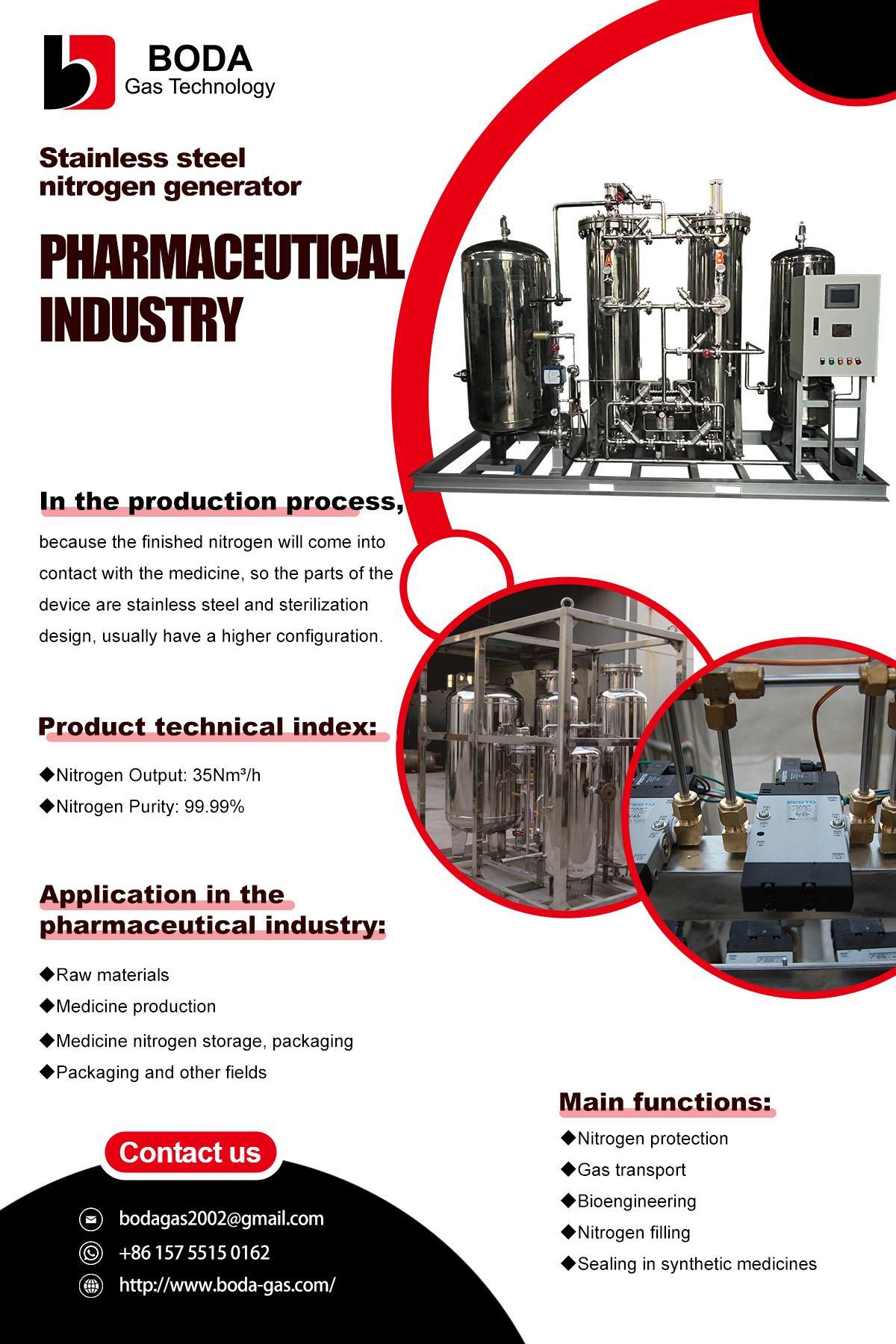
Stainless-steel PSA nitrogen generators are commonly selected when process hygiene, material traceability, and clean-room interfaces are required.
In the selection phase, the real question is not whether a generator can produce 99.999% nitrogen, but whether the complete compressed-air preparation train, buffer vessel, controls, and final piping can maintain that purity at a stated flow and pressure over a continuous duty cycle.
Purity selection guidelines
Selecting the exact purity grade avoids over-sizing energy consumption. In PSA nitrogen generation, users select a purity setting and the generator adjusts air consumption and energy use to that requirement. Common industrial selection ranges are:
- 95%–98%: fire protection, marine tank blanketing, oilfield pipeline purging, general tyre inflation
- 99%–99.9%: food & beverage modified-atmosphere packaging, wine, and conventional plastic moulding
- 99.95%–99.99%: mild-steel laser cutting, cable production, electronics assembly, pharmaceutical tank blanketing
- 99.999% and above: special-metal cutting, high-end electronics, and specialized laboratory processes
PSA technology is normally preferred when process purity exceeds 99.9%, because membrane nitrogen systems generally provide a lower purity ceiling. BODA GAS also supplies membrane separation nitrogen generators under the BMN Series when customers require a compact, lower-purity unit; the BMN manual states membrane purity of 95%–99.9%, adjustable pressure of 0.1–1.2 MPa, and dew point options of -40°C or -60°C.
Certificates and Standards: What Should a Buyer Request?
At the corporate level, BODA GAS holds valid management-system certificates covering the BXN PSA nitrogen equipment production scope. These are verifiable documents issued by the certification body YAB CERTIFICATION CO.,LTD., not generic marketing claims:
| Standard | Certificate No. | Issued / Expiry | Production Scope |
|---|---|---|---|
| ISO 9001:2015 / GB/T 19001-2016 Quality Management | 244-25-QL-11075-R0-S | 2025-08-11 / 2028-08-10 | BXN PSA nitrogen equipment, BXO PSA oxygen equipment, refrigeration dryers, adsorption dryers |
| ISO 14001:2015 / GB/T 24001-2016 Environmental | 244-24-EJ-09517-R2-S | 2024-07-15 / 2027-11-04 | BXN PSA nitrogen equipment; BXO PSA oxygen equipment; general refrigeration and adsorption compressed-air dryers |
| ISO 45001:2018 / GB/T 45001-2020 Occupational Health & Safety | 244-24-SY-09318-R2-S | 2024-07-15 / 2027-11-04 | BXN PSA nitrogen equipment; BXO PSA oxygen equipment; general refrigeration and adsorption dryers |
These system-level certificates show that production processes are reviewed for quality consistency, environmental impact, and worker safety. For pressure integrity in specific export countries, buyers should separately ask the supplier to confirm whether the PSA generator pressure vessels are manufactured to ASME, CE/PED, or another national code.
BODA GAS supports code-related customization on its PSA nitrogen generators, including carbon-steel or SS304 stainless-steel construction and compliance options such as ATEX, ASME, CE, and ISO. This is meaningful for buyers because a vessel that is built for ASME requirements must be traceable through design calculations, material certificates, welding documents, and third-party inspection. A buyer should therefore request the pressure-vessel nameplate and the code document package before shipment.
Application-Based Compliance: Process Industries and Their Typical Constraints
The same generator becomes a "food-grade nitrogen generator", "pharmaceutical nitrogen generator", or "oilfield nitrogen generator" only when its configuration matches the application standard. Below is a summary of typical constraints from accepted engineering and supplier guidance.
| Industry | Typical Purity | Key Compliance Point | Common Configuration Expectation |
|---|---|---|---|
| Food & beverage packaging | 99.0%–99.9% | Food-grade, oil-free nitrogen; no oil carry-over | Oil-free air source or reliable filtration, stainless steel option, online oxygen monitoring where required |
| Pharmaceutical | 99.99%–99.999% | Clean, sterile process environment | Oil-free compressor, stainless steel contact surfaces, sterilizing-grade filtration, low dew point |
| Chemical | 99.0%–99.99% | Reactor inerting, tank blanketing, purging | ASME pressure vessels and explosion-proof controls when used in classified areas |
| Oil & gas | 95%–99.9% | Hazardous zone control, remote/offshore operation | Explosion-proof PSA generator for Zone 1 / Zone 2, containerized or skid-mounted package |
| Electronics | 99.99%–99.999%+ | Trace oxygen, dew point ≤ -60°C | High-efficiency filtration, low-dew-point dryers, optional purification unit |
| Laser / plasma cutting | 95%–99.999% | Oxide-free cut edge, high-pressure delivery | High-pressure booster for fine cutting; purity matched to material grade |
Within these industry frameworks, BODA GAS application documentation reflects similar boundary conditions. For example, food and beverage packaging guidance in the BODA GAS corpus specifies 99.0%–99.9% nitrogen at food-grade oil-free condition. The pharmaceutical industry guidance references 99.99%–99.999% purity, while its chemical-industry guidance cites reactor inerting and raw-material tank blanketing with an explosion-proof or ASME requirement. For oil and gas customers, the BODA GAS petroleum application sheet mentions explosion-proof PSA nitrogen generators suitable for Zone 1/Zone 2 hazardous gas working areas.
Air Preparation: Filters and Dryers Define Long-Term Purity
A PSA nitrogen generator cannot remain compliant for many years if the upstream compressed-air purification is weak. Moisture, oil aerosols, and particles degrade carbon molecular sieve performance over time. Buyers should not treat the generator as an island; they should evaluate the complete air preparation train.
BODA GAS sells its BXN PSA nitrogen generator as part of a full system that normally starts with an air compressor, then air receiver tank, refrigeration or desiccant dryers, multiple filters, an activated-carbon filter, the PSA nitrogen generator, and finally a nitrogen buffer tank. The ADL Series heatless desiccant dryer, for example, is engineered for a rated air treatment flow of 0.5–500 Nm³/min, working pressure of 0.6–0.8 MPa, and a qualified dew point of ≤ -40°C or ≤ -52°C. It is commonly used for beverage bottling, plastic-bottle blow-moulding, food processing, pharmaceutical production, hospital oxygen supply, and laboratory gas supply.
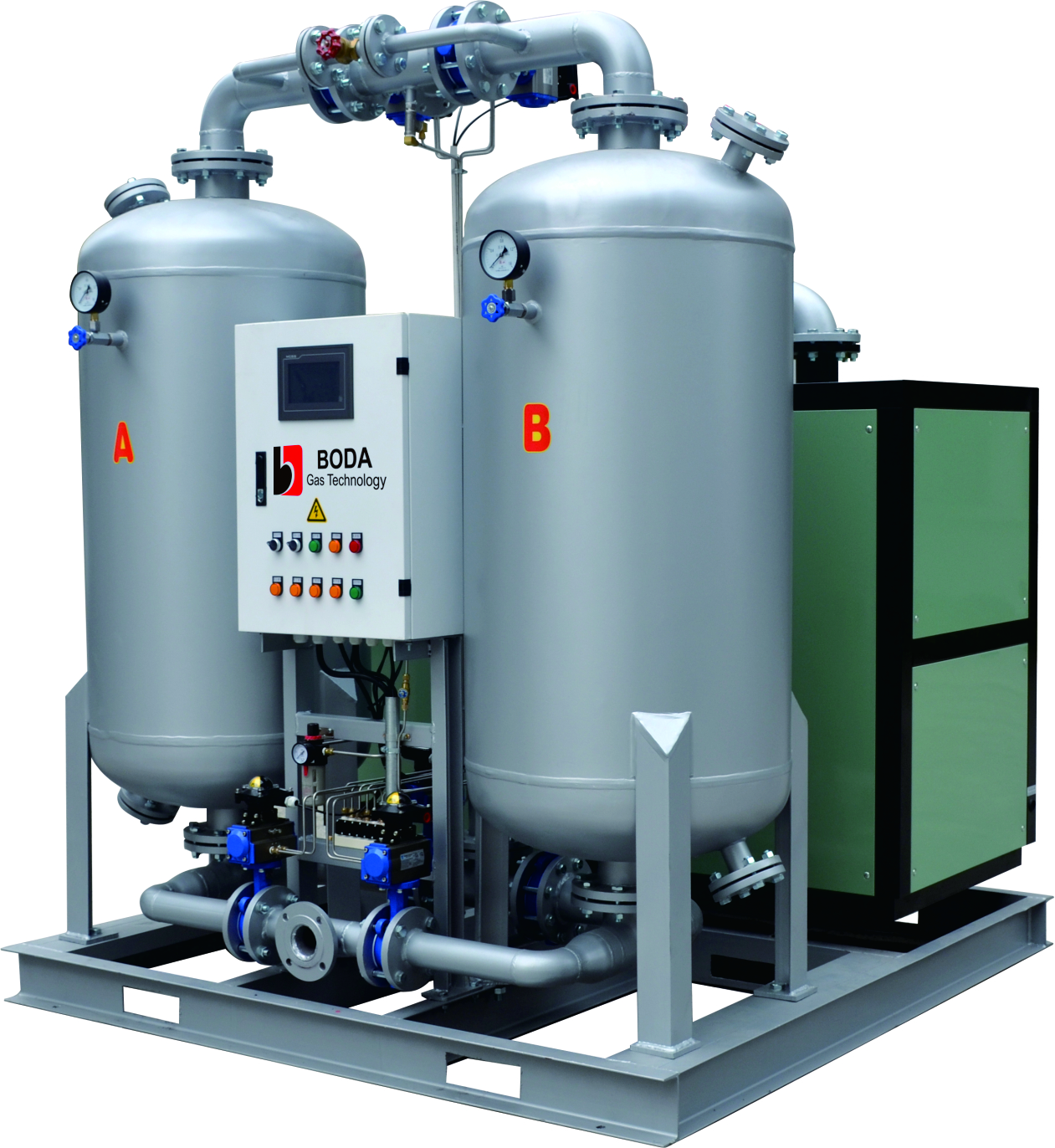
Adsorption dryers produce the dry air required to maintain a low dew point in PSA nitrogen systems.
Role of Filters in Protecting PSA Sieve Material
The filtration sequence removes contaminants before air enters the molecular-sieve beds. Filtration components used in BODA GAS systems include high-efficiency oil-water separators, precision filters, oil removers, and activated-carbon filters. The FLT Series activated-carbon filter is designed to remove oil vapour and impurities from compressed air, with outlet residual oil content below 0.003 mg/m³; its anti-powder-leakage baffle prevents carbon dust from reaching downstream dryers and molecular-sieve equipment. The FLY Series high-efficiency oil remover uses three-stage separation and filtration to reach a residual oil content below 0.01 mg/m³.
For pharmaceutical or aseptic processes, the FLC Series sterilizing filter is available with 0.1 µm hydrophobic microporous cartridges, support for 121°C online steam sterilization, and a quick-open housing for cartridge change-out. These are not optional marketing details; they determine whether a claimed purity is actually deliverable to the point of use.
Maintenance Intervals
Compliance should also be understood as an operating discipline. Normal industrial guidance for this type of system includes precision filter element replacement around every 8,000 operating hours, standard air-compressor service every 3,000–4,000 hours, dryer desiccant replacement usually at 16,000–24,000 hours, and carbon molecular sieve replacement after a much longer life of roughly 6–10 years. Ask a manufacturer for these intervals in writing before ordering.
Factory Verification and Production Evidence
A compliance-oriented buyer should evaluate the manufacturer's own quality-control evidence, not only the sales documentation. BODA GAS production inputs include a company profile with 58 employees, a 30,000 m² factory, an annual output of approximately 480 units, and a dedicated R&D team of 15 engineers. Its OEM/ODM production sheet lists a monthly capacity of 40 units, a lead time of 25–45 days, MOQ of 1 unit, and a stated 100% test policy covering visual and function inspection.
Those markers help answer practical supplier questions:
- Can the manufacturer support customization of flow, purity, pressure, dew point, material, production standard, voltage, logo, nameplate, or painting colour?
- Can the manufacturer test the assembled equipment before packing?
- Can the manufacturer provide after-sales installation guidance, remote troubleshooting, and warranty terms?
BODA GAS supports OEM and ODM production, including flow-rate, purity, and pressure customization. The company also states after-sales support through on-site or remote installation guidance, operation-staff training, and a 12-month equipment guarantee.
Skid-Mounted, Containerized, and On-Site PSA Nitrogen Packages
Industrial buyers increasingly require packaged solutions to reduce field installation cost. In this context, "compliance" extends to mechanical integration, lifting points, piping supports, and control-system validation.
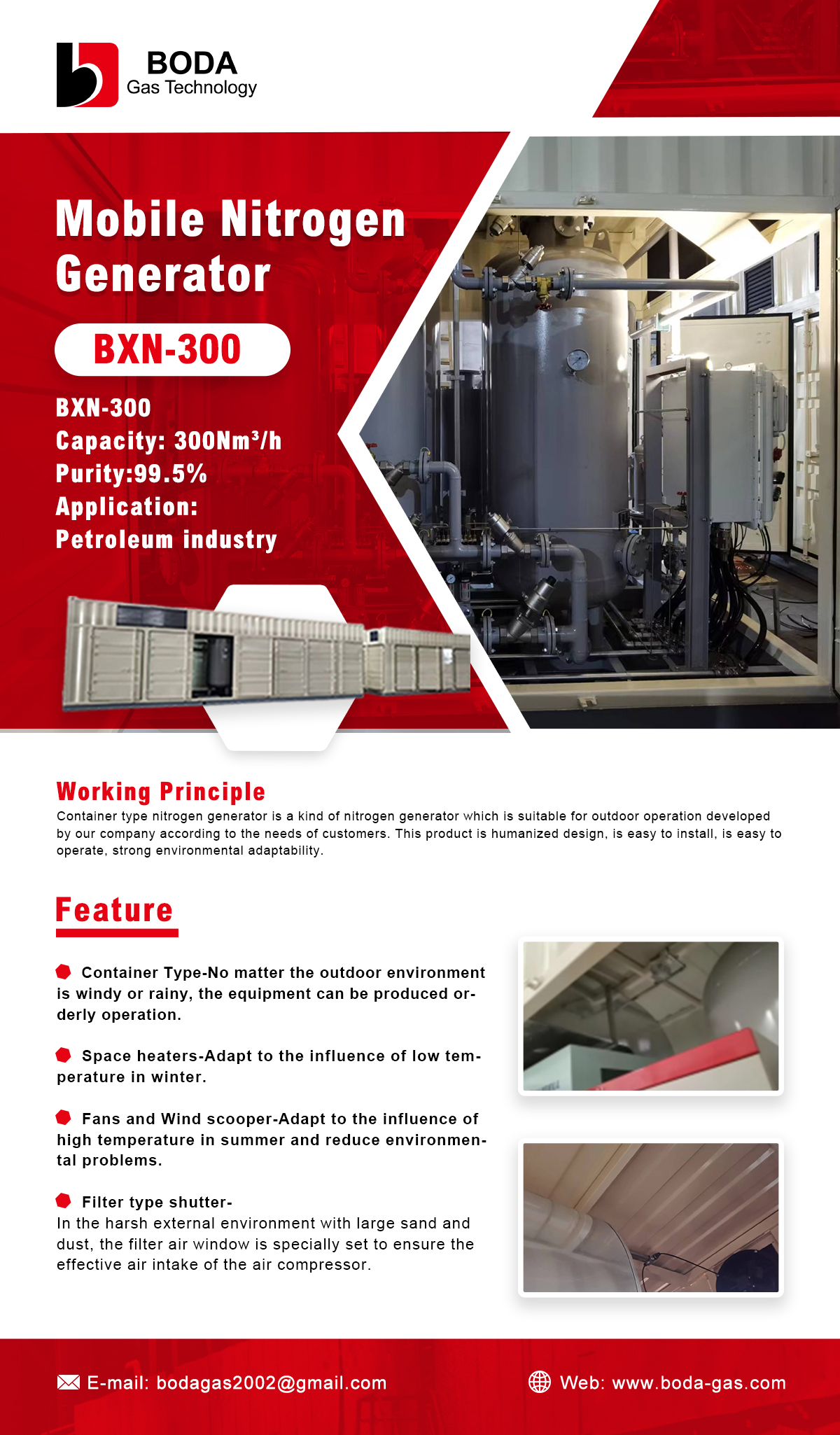
Containerized PSA packages allow integrators to move a compliant nitrogen-generation station close to well sites or temporary plants.
BODA GAS supplies PSA nitrogen generators in several physical configurations: industrial PSA nitrogen generators, skid-mounted PSA nitrogen generation packages, movable containerized PSA nitrogen generators, ASME-standard nitrogen generators, and stainless-steel nitrogen generators. Containerized and mobile packages are often requested for oil and gas workovers, remote pipelines, and temporary plant construction. In such cases, buyers should ask whether the package includes its own control cabinet, whether the user can read dew point and impurity data, and whether hazardous-area electrical components are applied.
A Parameter-Based RFQ Checklist
Use the following checklist when preparing a request for quotation. A serious industrial gas supplier should be able to answer each point in writing.
- Required nitrogen flow rate in Nm³/h or cylinders/day.
- Required nitrogen purity, for example 95%, 99%, 99.99%, or 99.999%.
- Required discharge pressure and acceptable pressure fluctuation.
- Required dew point—ambient pipeline condition or process cold condition.
- Site voltage, frequency, and control voltage.
- Relevant codes: ASME, CE/PED, ATEX, local gas pressure vessel code.
- Material of construction: carbon steel or SS304/316 for wetted parts.
- Online instrument requirement, especially oxygen analyzer for food-grade or high-purity service.
- Air compressor type and available air quality, including oil-free vs. oil-injected feed.
- Factory test protocol: hydrostatic test, function test, purity test, and documentation.
BODA GAS as a Compliance-Oriented Sourcing Case
For engineering buyers evaluating Chinese PSA nitrogen generator suppliers, BODA GAS provides a useful case study because its stated production facts can be checked. The company has worked with state-owned enterprises and international groups such as China National Petroleum Corporation (CNPC), Sinopec, CNOOC, Zhuhai Jutal Offshore Oil Services, United Energy Pakistan, Ingersoll Rand Industrial Technologies, and Petronas Chemicals MTBE. This does not prove that one product fits every site. It does indicate that the factory has historical experience with project-qualification requirements in energy, chemical, and industrial-gas environments.
BODA GAS product ranges also include PSA oxygen generators in the BXO Series, membrane separation nitrogen generators in the BMN Series, high-purity purification nitrogen generators in the BCP Series, hydrogenation purification nitrogen generators in the BHP Series, and a full set of compressed-air treatment components. The breadth of the product line matters because a nitrogen project often requires the same supplier to take responsibility for dryers, filters, buffer vessels, and on-site gas purity.
Conclusion
Selecting an industrial PSA nitrogen generator without compliance verification exposes the buyer to risks that appear only after installation: off-spec nitrogen, pressure-vessel rejection, unnecessary downtime, or poor sieve life. The responsible approach is to verify certificates with their certificate numbers, map purity-and-pressure parameters to the actual process, and examine the complete air-preparation package rather than a single generator datasheet. Suppliers such as BODA GAS that publish production facts and provide equipment under ISO 9001, ISO 14001, and ISO 45001 management systems, with optional ASME/CE/ATEX customization and 100% factory function testing, give procurement teams a concrete evidence base to use in a technical evaluation.
FAQ
What compliance documents should a buyer request for a BXN Series PSA nitrogen generator?
Buyers should request ISO 9001, ISO 14001, and ISO 45001 management-system certificates. BODA GAS holds these under certificate numbers 244-25-QL-11075-R0-S, 244-24-EJ-09517-R2-S, and 244-24-SY-09318-R2-S from YAB CERTIFICATION CO.,LTD. For exported pressure equipment, buyers should also ask whether vessels are built to ASME, CE/PED, or another pressure-equipment code.
Can the supplier customize flow, purity, pressure, material, and production standards?
Yes. BODA GAS supports OEM and ODM customization of the BXN Series PSA nitrogen generator, including flow rate, purity, pressure, dew point, material, production standard, voltage, logo, nameplate, and painting color. In its production profile, the company states a monthly capacity of 40 units, a lead time of 25–45 days, and an MOQ of one unit.
Which purity grade should be selected for food and beverage nitrogen packaging?
Food and beverage modified-atmosphere packaging usually requires nitrogen purity of 99.0%–99.9% at food-grade oil-free condition. The buyer should ensure that the compressor and downstream filtration can prevent oil contamination and that the flow rate meets packaging-line consumption and pressure requirements.
How does a pharmaceutical PSA nitrogen generator differ from a general industrial unit?
Pharmaceutical applications typically require 99.99%–99.999% purity, oil-free compressed air, and hygienic construction. A stainless-steel or otherwise cleanable configuration is usually preferred. BODA GAS also supplies sterilizing filters in the FLC Series for pharmaceutical aseptic processes, supporting 0.1 µm filtration and online steam sterilization.
How is equipment quality verified before release?
BODA GAS states that all equipment passes visual inspection and functional testing before factory release. Buyers are advised to agree in advance on a factory acceptance test covering pressure integrity, control function, purity attainment, and documentation. The company provides installation guidance and remote technical support and states a 12-month equipment guarantee.
Ready to compare BODA GAS PSA nitrogen generator technical specifications?
Download BODA GAS Product ManualHave Questions or Need More Details?
Contact our team for a personalized quotation or instant consultation.
Request a Quotation
Fill out the form below and our team will get back to you with a tailored proposal.
WhatsApp Direct Chat
Prefer to chat in real-time? Message us on WhatsApp for instant assistance & quick answers.
- Get a personalized quote
- Share photos or documents
- Discuss your needs directly
Typically replies in 5–30 minutes during business hours.