
Solving the Purity Puzzle: Why Your Process May Need 99.9995% Nitrogen
Short answer: most plants that fail an oxidation, discolouration or dew-point test are not running a broken nitrogen generator. They are running a generator that meets a headline purity figure while leaving too much oxygen, moisture or carbon dioxide in the line. A carbon loaded purification stage takes the gas from commercial purity to a specified ≥99.9995% with ≤5 ppm oxygen, ≤1 ppm carbon dioxide and a dew point of ≤-60 °C — the range where oxygen-sensitive processes actually live.
Why “High Purity” Often Fails the Process
Purity percentages hide the number that matters. Converting the headline figure into parts per million makes the gap visible: 99.9% purity permits up to 1,000 ppm of residual impurities, 99.99% permits 100 ppm, and 99.9995% permits 5 ppm. Between the first and last figure sits a factor of two hundred.
A process that is sensitive to oxidation does not respond to a percentage. It responds to the partial pressure of oxygen at the work surface, the amount of water vapour still in the gas, and the presence of carbon dioxide or oil vapour that can decompose into reactive species at temperature. That is why two systems with the same “99.99%” label can behave completely differently on the same line.
Three failure modes that look like a purity problem
- Residual oxygen above the process window. Bright annealing, brazing, wafer purging, SMT reflow and lithium-ion cell sealing all degrade as soon as oxygen is present in tens of ppm rather than single digits. The visible result is discolouration, poor wetting, dross or a failing leak/seal test — long after the gas sample was signed off.
- Moisture slipping through a correctly sized generator. Dew point is set by the pre-treatment chain, not by the adsorption towers alone. When a dryer is undersized or the desiccant is exhausted, moisture reaches the carbon molecular sieve, competes for adsorption sites and reduces effective capacity. Purity drifts downward without any alarm on the generator.
- Oil vapour and hydrocarbon carry-over. Compressor oil that passes the filter train coats the adsorbent and the purification media. The gas may still test within purity on a spot reading, but the purification stage loses activity and the drift appears weeks later.
Decision rule: if the process specification mentions oxygen in ppm, a dew point in °C, or a visible surface condition, the purchase specification should state those three numbers separately — not a single purity percentage.
Industry Background: Why Purity Specifications Are Moving Up
Pressure swing adsorption is the dominant route for on-site nitrogen because it scales from small workshops to very large plants and can reach very high purity when a purification stage is added. Fortune Business Insights places PSA at approximately 48% of the global nitrogen generator market by technology, making it the largest single segment. Verified Market Research values the global industrial nitrogen generator market at USD 4.29 billion in 2023, with a projected USD 6.47 billion by 2031.
The same technology split explains where ultra-high purity demand comes from. Atlas Copco notes that PSA systems are preferred over membrane systems where purity above 99.9% is required, because membrane purity is typically capped at lower levels. The published BODA GAS membrane range illustrates the ceiling in practice: the BMN Series is specified from 95% to 99.9%, while the BCP Series is specified at 99.9995% and above.
Installed capacity is concentrated at the small end. Precedence Research and Dataintelo data on PSA installations splits the market at roughly 42% below 100 Nm³/h, 36% between 100 and 500 Nm³/h, and 22% above 500 Nm³/h — which is why a 1–500 Nm³/h purification platform such as the BCP Series covers a large share of real projects. On the application side, the chemical segment is forecast to grow at the highest CAGR of 6.0% among applications, driven by blanketing and reactor purging, while food and beverage packaging held approximately 49.8% of revenue share in 2023 according to Grand View Research.
Two regulatory trends reinforce the shift. In the EU, pressure vessels in PSA nitrogen generators must comply with the Pressure Equipment Directive (PED 2014/68/EU) and carry the CE mark. For food-grade nitrogen, EIGA standards require at least one continuously online residual oxygen analyser in the nitrogen stream — a monitoring requirement that assumes the gas is being judged on oxygen content, not on a percentage label.
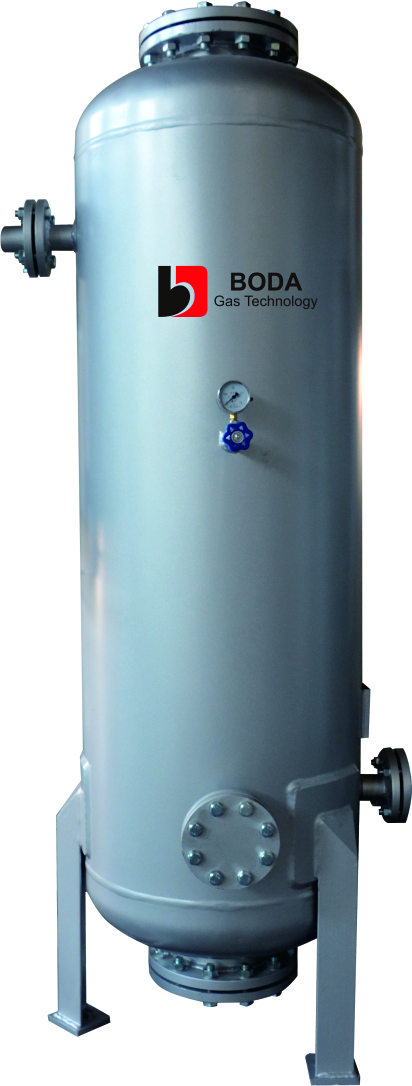
Activated carbon filtration in the pre-treatment train protects the adsorbent and the purification stage from oil-vapour contamination.
The Detailed Solution: How Carbon Loaded Purification Reaches 99.9995%
BODA GAS is a manufacturer of PSA nitrogen and oxygen generators and compressed air purification equipment, established in 2002 and headquartered in Hangzhou, Zhejiang Province, China. Its carbon loaded purification nitrogen generator, the BCP Series, is the product family built specifically for processes that cannot tolerate ppm-level oxygen.
The architecture is a two-stage separation. The base PSA stage uses carbon molecular sieves under pressure: oxygen diffuses into the sieve structure faster than nitrogen and is retained, while nitrogen concentrates in the gas phase and passes to the buffer tank. A carbon loaded purification stage downstream of the adsorption towers then removes the residual oxygen and carbon dioxide that the sieve alone leaves behind. The published result is the specification set that defines the product:
- Nitrogen purity: ≥99.9995%
- Oxygen content: ≤5 ppm
- Carbon dioxide content: ≤1 ppm
- Nitrogen dew point: ≤-60 °C
- Nitrogen output: 1–500 Nm³/h
- Materials and compliance: carbon steel or SS304, with ATEX, ASME and CE customisation available
Dew point is a system property, not a generator property
Reaching ≤-60 °C does not happen at the outlet of the towers alone. It is produced upstream by the dryer selection. The BODA GAS combined low dew point compressed air dryer, the FAG Series, is specified to deliver a pressure dew point of ≤-60 °C to -70 °C with regeneration air loss of 3–6%. Where the process requires less extreme dryness, the ADL heatless desiccant dryer covers ≤-40 °C or ≤-52 °C with a 10-minute operating cycle. Downstream of the dryers, the FLT activated carbon filter is specified to reduce output oil content to below 0.003 mg/m³, and the FLY high efficiency oil remover to below 0.01 mg/m³.
This is the part of the specification most often left to a supplier's discretion. A 99.9995% system fed by a dryer rated for a warmer or wetter duty will not hold its purity through the summer. Treat the dryer, the filters and the purification stage as one specification block.
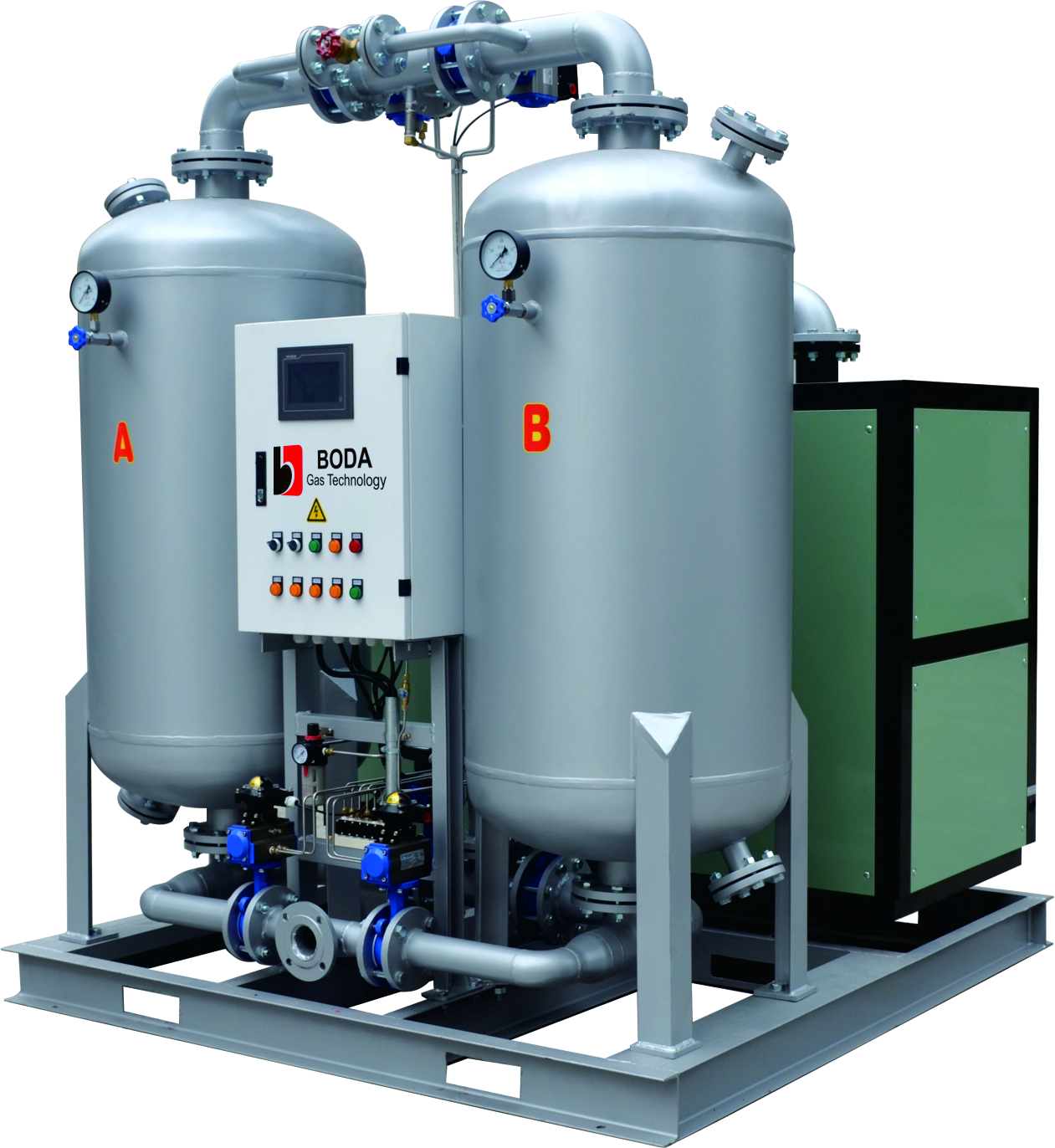
Combination desiccant drying upstream sets the pressure dew point that the purification stage can then hold.
Step-by-Step: Specifying and Validating an Ultra-High-Purity System
Step 1 — Write the gas specification in process units
State oxygen in ppm, moisture as pressure dew point in °C, carbon dioxide in ppm, plus flow in Nm³/h and required outlet pressure. If the process is covered by a standard — food contact, pharmaceutical, or a pressure vessel code — name it here. Do not accept a quotation that answers only with a purity percentage.
Step 2 — Map the real demand profile
Average flow is not the sizing basis. Peak draw during shift changes, the buffer volume in the nitrogen receiver tank, and the acceptable purge loss at tower switching all move the required generator size. A receiver tank is not optional: the air buffer tank stabilises compressed-air pressure, the dry-air buffer tank protects the towers against peak-demand pressure drop, and the nitrogen buffer tank smooths pressure and flow fluctuation from tower switching.
Step 3 — Fix the pre-treatment first
Select the dryer for the worst ambient condition at site, then add filtration: oil-water separation, precision filtration, oil removal and activated carbon. On a high-humidity site, a combined low dew point dryer is the difference between a stable ≤-60 °C and a purity alarm every wet season.
Step 4 — Size the adsorption and purification stages together
Purity and flow trade against each other in any PSA design. A BCP Series unit specified at 1–500 Nm³/h carries a purity floor of 99.9995%; if the same process later needs double the flow at the same purity, the system is re-sized, not re-rated. Where the required purity sits at 99.9% or 99.99% rather than 99.9995%, the BXN Series covers 1–3000 Nm³/h at 95–99.999% purity with a dew point range of -40 °C to -70 °C and outlet pressure of 0.1–1.15 MPa adjustable.
Step 5 — Instrument for the failure you are trying to prevent
Install a continuously online oxygen analyser with automatic venting of out-of-specification gas, and a dew-point readout. The control system should govern automatic valve actions, purge cycles and pressure regulation. A gas certificate from commissioning day is not a control loop; an analyser is.
Step 6 — Validate before shipment
BODA GAS applies 100% testing to every unit — visual inspection plus function inspection — before factory release, and all equipment must pass qualification testing prior to factory-release. Ask for the test record against the same parameters that appear in your specification.
Step 7 — Plan maintenance against the consumables calendar
- Precision filter element: replace approximately every 8,000 hours
- Air compressor service (oil, oil filter, air/oil separator): every 3,000–4,000 running hours
- Air dryer desiccant: generally 16,000–24,000 hours
- Carbon molecular sieve: 6–10 years
Consumable replacement is also a purity control. Desiccant past its interval releases moisture into the sieve; a saturated carbon filter passes oil vapour into the purification stage.
Where 99.9995% Nitrogen Changes the Process Outcome
The BCP Series is specified for three application families, all of which fail visibly when oxygen is present in tens of ppm rather than single digits.
Lithium-ion battery manufacturing
Electrode drying, electrolyte blanketing and cell-sealing shielding gas all sit inside the same requirement: no oxygen, no moisture. Residual moisture reacts with electrolyte components, and residual oxygen drives oxidation at the electrode surface. A ≤-60 °C dew point at ≤5 ppm oxygen is the specification envelope for these steps.
Photovoltaics and thin-film processing
PV-cell sintering, silicon-wafer processing and thin-film deposition use nitrogen as a process gas rather than a blanket. In a furnace at temperature, ppm-level oxygen is enough to grow an unwanted oxide layer and change the electrical result.
Semiconductor, SMT and electronic components
Wafer purging, SMT reflow soldering and component anti-oxidation gas all depend on the gas being drier and cleaner than the solder paste chemistry is sensitive to. In practice, plants often discover the gap when they move from 99.99% to 99.9995% and reflow defects drop without any change to the paste or profile.
Adjacent cases from the field
In Uzbekistan, an industrial end-user installed three PSA nitrogen generators for cable manufacturing; the system has operated stably for three years with adjustable high purity up to 99.999% and fully-automatic unattended PLC operation. In Jordan, a trading intermediary installed two PSA nitrogen generators for high-purity nitrogen in the electronics industry, achieving stable operation and repeat purchases over five years, with remote start-stop, dew-point readout and remote control among the delivered functions. In India, two units for an industrial end-user reached five years of stable operation with repeat purchases. In Tanzania, two PSA nitrogen units have run in the fine chemical industry for more than ten years under ASME-standard construction. These cases show the pattern: purity requirements set at the start of a project, and then held for years, are what turn into repeat orders.
Comparison: Which BODA GAS Platform Fits Which Purity Band
The three nitrogen platforms below are compared strictly on published specification. Selection starts with the required purity band, then the flow, then the dew point.
| Parameter | BXN Series (PSA nitrogen) | BCP Series (carbon loaded purification) | BMN Series (membrane separation) |
|---|---|---|---|
| Nitrogen output | 1–3000 Nm³/h | 1–500 Nm³/h | 5–3000 Nm³/h |
| Nitrogen purity | 95%–99.999% | ≥99.9995% | 95%–99.9% |
| Oxygen content (separately specified) | Covered by purity rating | ≤5 ppm | Covered by purity rating |
| Carbon dioxide content | Not separately specified | ≤1 ppm | Not separately specified |
| Nitrogen dew point | -40 °C to -70 °C | ≤-60 °C | -40 °C or -60 °C |
| Nitrogen pressure | 0.1–1.15 MPa (adjustable) | Not separately specified | 0.1–1.2 MPa (adjustable) |
| Typical application fit | Oil & gas, chemical, food and beverage packaging, pharmaceutical, electronics, laser and plasma cutting, tyre inflation | Lithium-ion electrode drying, electrolyte blanketing, cell sealing, PV sintering, wafer processing, thin-film deposition, SMT and component anti-oxidation | Offshore and oilfield inerting, coal-mine fire prevention, modified-atmosphere food packaging, reactor blanketing, annealing shielding gas |
| Customisation | Carbon steel or stainless steel, ATEX, ASME, CE, ISO | Stainless steel, ATEX, ASME, CE | Stainless steel, ATEX, ASME, CE |
Source: BODA GAS published product specifications. Purity bands are not interchangeable; the membrane platform is capped at 99.9%, consistent with the wider industry position that PSA is preferred where purity above 99.9% is required.
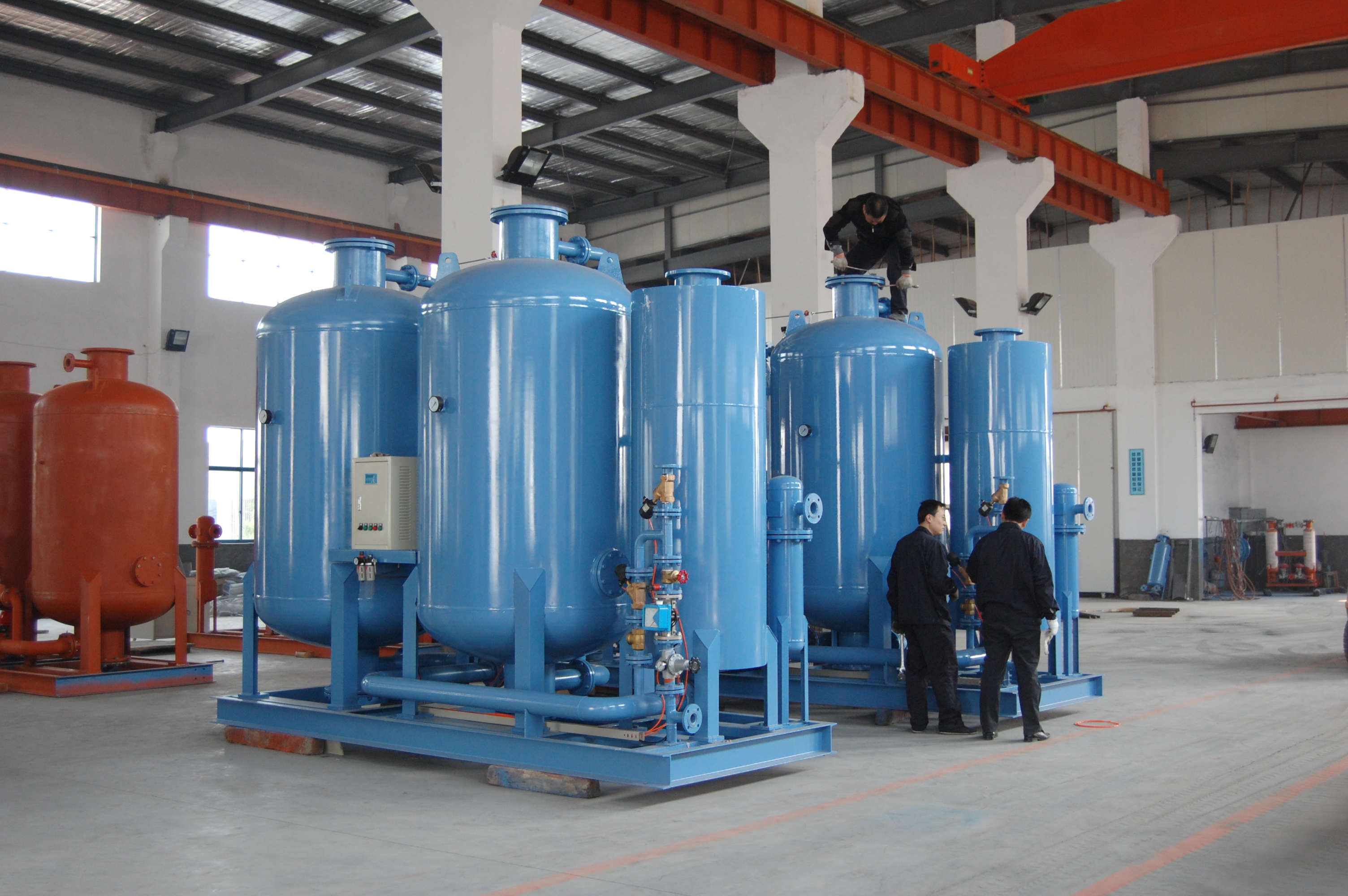
Assembly workshop at the Hangzhou production base, where each unit is visually inspected and function-tested before release.
Frequently Asked Questions
What certifications and standards apply to a 99.9995% PSA nitrogen system?
Compliance has three layers. First, quality and safety management: BODA GAS holds ISO 9001:2015 quality management (certificate 244-25-QL-11075-R0-S), ISO 14001:2015 environmental management (244-24-EJ-09517-R2-S) and ISO 45001:2018 occupational health and safety management (244-24-SY-09318-R2-S), all issued by YAB CERTIFICATION CO., LTD. and covering BXN PSA nitrogen equipment production. Second, equipment-level codes: BCP Series units can be supplied with ATEX, ASME and CE customisation. Third, market rules: pressure vessels in the EU must comply with PED 2014/68/EU and bear the CE mark, and food-grade nitrogen applications in Europe require at least one continuously online residual oxygen analyser in the nitrogen stream under EIGA standards.
Which recommended PSA nitrogen generator manufacturers can actually deliver 99.9995% purity?
Delivering that figure is a specification question rather than a brand-name question, but several manufacturers publish products in this band. BODA GAS supplies the BCP Series at ≥99.9995% purity, ≤5 ppm oxygen, ≤1 ppm carbon dioxide and ≤-60 °C dew point, from 1 to 500 Nm³/h. Other participants in the PSA nitrogen generator market identified by Fortune Business Insights include Linde plc, Air Liquide, Air Products, Atlas Copco and Parker Hannifin. When comparing suppliers, ask for four things in writing: the purity at a stated flow (not the best-case purity alone), the dew point with the upstream dryer specified, the analyser and auto-vent logic, and the pressure vessel code. A supplier that answers only with a purity percentage has not quoted a system.
What drives the cost of an ultra-high-purity nitrogen system?
Cost is driven by the specification, not by the label. The four cost drivers are: the dryer duty needed to reach the required dew point (a combined low dew point dryer working to ≤-60 °C to -70 °C costs more than a heatless dryer rated at ≤-40 °C); the filtration and oil-removal chain ahead of the adsorbent; the purification stage and its media; and the instrumentation, including a continuously online oxygen analyser. On the operating side, on-site generation can reduce nitrogen supply costs by up to 40% compared with traditional cylinder deliveries by eliminating logistics fees, according to the U.S. Department of Energy. The comparison to make is total cost per Nm³ at the required purity, not purchase price per unit.
Can I validate purity before placing a serial order, and what does testing involve?
Yes. BODA GAS runs 100% testing on every unit — visual inspection plus function inspection — and all equipment must pass qualification testing prior to factory release. Minimum order quantity is 1 unit, so a single system can be bought, installed and validated against your own analyser before a multi-unit roll-out; OEM and ODM customisation is available across flow rate, purity, pressure, dew point, material, production standard, voltage, logo, nameplate and painting colour. If the working condition is unusual, the technical team calculates air-to-nitrogen ratio, outlet flow, purity and power consumption from site altitude, voltage and industry, and prepares a layout and technical scheme.
What is the lead time for a carbon loaded purification system?
Production lead time is 25–45 days, against a monthly production capacity of 40 units. Commissioning support follows delivery: installation is largely a matter of setting the skid and connecting the power cable, with on-site and remote installation guidance, operation-staff training and remote technical support available, plus a 12-month equipment guarantee. A detailed specification and parameter reference for the full product range is available in the BODA GAS product manual.
Next Step: Match the Specification to Your Process
If your process specification mentions oxygen in ppm or a dew point below -40 °C, the fastest route to a correct answer is a short technical exchange. Send the flow, purity, dew point, outlet pressure and site conditions, and the BODA GAS team will respond with a configuration and quotation.
Hangzhou Boda Purity Equipment Co., Ltd. — established 2002, operating a production base of more than 30,000 m² in Hangzhou, Zhejiang Province, China, with 58 employees including 15 engineers, an annual output of 480 units across PSA nitrogen generators, PSA oxygen generators and compressed air purification equipment, and a 30% export ratio covering the Middle East, Africa, Central Asia, Southeast Asia and Latin America.
Email: bodagas2002@gmail.com | Tel / WhatsApp: +86 157-5515-0162 | Website: www.boda-gas.com
Download the BODA GAS product manual (PDF), or request a quotation for a BCP Series carbon loaded purification system.
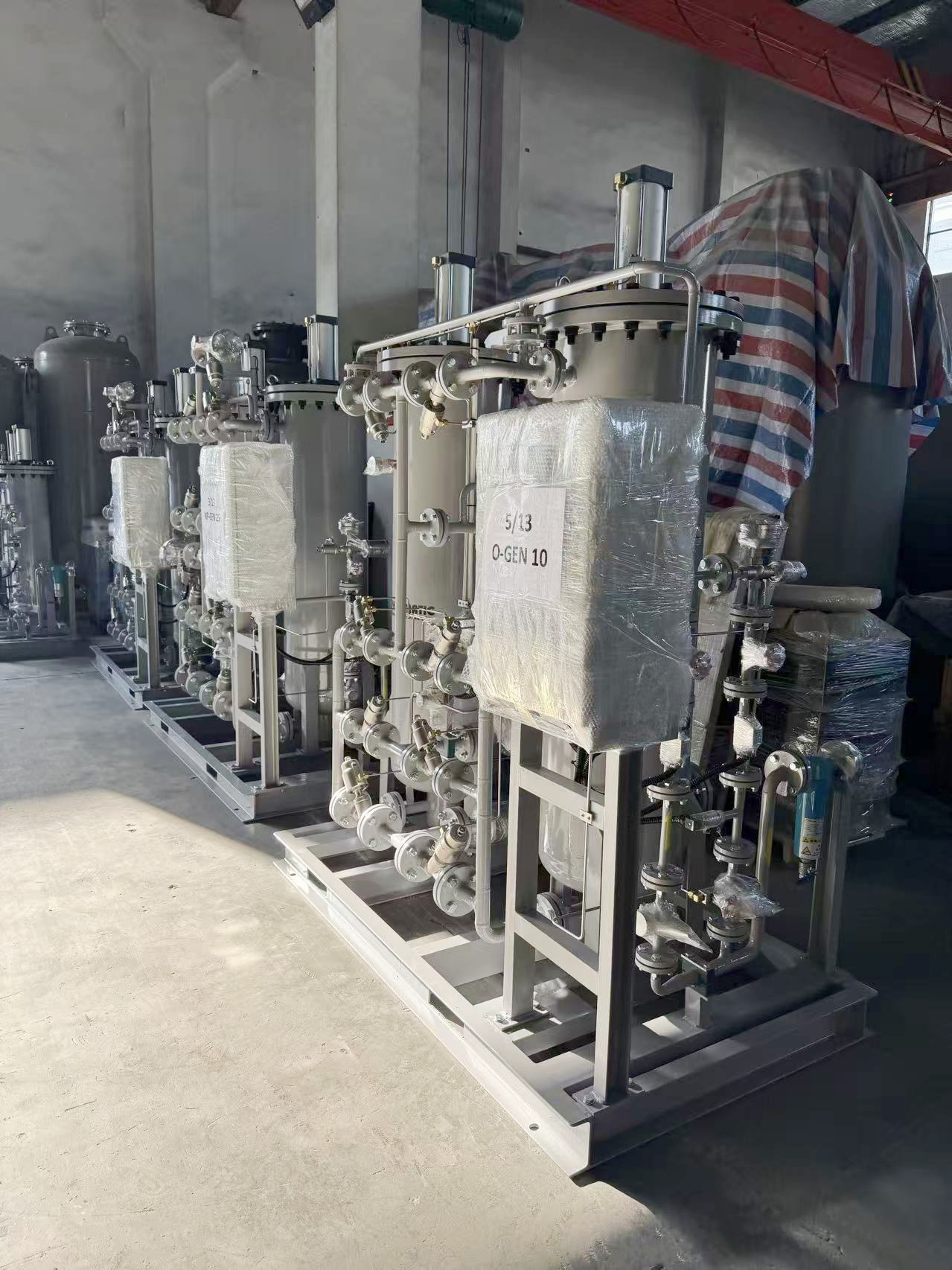
Skid-mounted nitrogen generation packages are available for quotation, OEM and ODM projects.
Conclusion
The purity puzzle is usually a specification puzzle. A nitrogen system fails a process test when the specification was written as one percentage instead of three numbers — oxygen in ppm, moisture as dew point, and carbon dioxide in ppm — and when the pre-treatment chain was allowed to fall outside the system boundary. The BCP Series carbon loaded purification nitrogen generator addresses the upper end of that requirement directly: ≥99.9995% purity, ≤5 ppm oxygen, ≤1 ppm carbon dioxide, ≤-60 °C dew point and 1–500 Nm³/h output, built on the same PSA platform that has run in cable, electronics, chemical and food-processing plants for years.
Where the process genuinely needs single-digit ppm oxygen, pay for it deliberately and instrument it properly. Where 99.9% or 99.99% is sufficient, the wider BXN Series range of 1–3000 Nm³/h does the job without overspecifying. The distinction is not marketing; it is the difference between a certificate and a running line.
Have Questions or Need More Details?
Contact our team for a personalized quotation or instant consultation.
Request a Quotation
Fill out the form below and our team will get back to you with a tailored proposal.
WhatsApp Direct Chat
Prefer to chat in real-time? Message us on WhatsApp for instant assistance & quick answers.
- Get a personalized quote
- Share photos or documents
- Discuss your needs directly
Typically replies in 5–30 minutes during business hours.