
Understanding Dew Point Requirements in PSA Nitrogen Pre-Treatment
Understanding Dew Point Requirements in PSA Nitrogen Pre-Treatment
A PSA nitrogen generator can only deliver the nitrogen quality that the air reaching its carbon molecular sieve (CMS) beds allows. The adsorption of excess moisture reduces the adsorption performance of the molecular sieve, and oil poisoning is one of the most important failure forms of oxygen-generator and nitrogen-generator adsorbents. Dew point in PSA nitrogen pre-treatment is therefore a system requirement rather than a dryer catalogue number: the air dryer installed in front of the beds has to hold the required dryness at the flow, pressure and inlet temperature the site actually operates at.
BODA GAS — Hangzhou Boda Purity Equipment Co., Ltd., a PSA gas separation equipment manufacturer established in 2002 — builds that pre-treatment stage around three dryer families: FAD Series refrigeration dryers, ADL Series heatless desiccant dryers and ADH Series heated desiccant dryers, with rated air treatment flows up to 500 Nm³/min and an optional working pressure range up to 3.0 MPa. This guide explains where a dew point requirement comes from, what each dryer family can deliver, and how to choose between them using air flow, working pressure and inlet temperature as the primary criteria.
What a Dew Point Requirement Actually Describes in a PSA Nitrogen System
Dew point is the temperature at which the water vapour carried in a gas begins to condense. In a compressed-air or nitrogen system, the figure that matters is the dew point at the point of use, because that is where condensation, corrosion or process contamination would appear. Two positions need to be kept apart during selection: the dew point a dryer can deliver, and the dew point the process actually requires.
The process requirement normally originates in one of three places:
- The generator specification. A BXN Series PSA nitrogen generator is rated for nitrogen dew point of –40 °C to –70 °C, with nitrogen purity of 95% to 99.999% and nitrogen flow rate of 1–3000 Nm³/h.
- The end-use point. BODA GAS application data for chip-and-wafer precision manufacturing in the electronics industry lists 99.999% to 99.9999% nitrogen purity with dew point ≤ –60 °C, while a common SMT workshop is listed at 99.99%.
- The site's operating reality. Desiccant dryer specifications are quoted against stated inlet conditions — for the ADL and ADH Series, an inlet temperature below 38 °C. A compressor room running hotter than the quoted condition will not reproduce the catalogue dew point without additional cooling.
The mismatch most often seen in the field is a refrigeration dryer standing in for a desiccant dryer. A FAD Series refrigeration dryer delivers qualified air dew point of ≤ –23 °C (under ambient pressure). That is useful protection for a compressed-air network, and it is a reasonable first stage, but it is a different dew point class from the –40 °C to –70 °C nitrogen dew point the generator itself is rated for. Desiccant dryers — the ADL Series heatless type and the ADH Series heated type — reach ≤ –40 °C or ≤ –52 °C qualified air dew point, which is the class normally installed directly ahead of CMS beds.
A continuous cost is also built into the dryer choice. Regeneration of a desiccant dryer consumes part of the dried air, and that air has to be produced by the compressor. The ADL Series heatless desiccant dryer is rated for regeneration air loss of ≤ 12%; the ADH Series heated desiccant dryer is rated at ≤ 6%. The difference is paid every hour of operation, which makes purge consumption a decision criterion rather than a footnote.
Industry Background: Why Pre-Treatment Has Become a Specification Item
Pressure swing adsorption is the largest nitrogen generation technology segment in the equipment market. PSA accounts for approximately 48% of global nitrogen generator market share (Fortune Business Insights, 2024), and PSA nitrogen generators can produce nitrogen with a purity rating of up to 99.999% using carbon molecular sieves (General Air Products, 2024). The wider industrial nitrogen generator market was valued at USD 4.29 billion in 2023 and is projected to reach USD 6.47 billion by 2031 (Verified Market Research, 2024).
Demand is spread across applications with quite different dryness expectations. Food and beverage held approximately 49.8% of nitrogen generator revenue share in 2023, largely through modified atmosphere packaging (Grand View Research, 2023). The chemical industry segment is expected to grow at the highest CAGR of 6.0% among applications, driven by blanketing and reactor purging (Maximize Market Research, 2024), and Asia-Pacific is projected to hold a 35% market share by 2032 (Verified Market Research, 2024). At the same time, on-site nitrogen generation can reduce nitrogen supply costs by up to 40% compared with traditional cylinder deliveries by eliminating logistics fees (U.S. Department of Energy, 2024).
Two consequences follow for pre-treatment design. First, because PSA equipment is now specified across food, chemical, pharmaceutical, electronics and oil-and-gas duty, the dryer cannot be selected by a default assumption; each duty sets its own dew point class and its own air-quality chain. Second, PSA is generally preferred over membrane separation where purity above 99.9% is required, because membrane purity is typically capped at lower levels (Atlas Copco). Higher purity targets place more weight on keeping the adsorbent dry and oil-free across the whole service life.
Solution: Matching FAD, ADL and ADH Dryers to the Duty
FAD Series refrigeration dryer — first-stage moisture removal
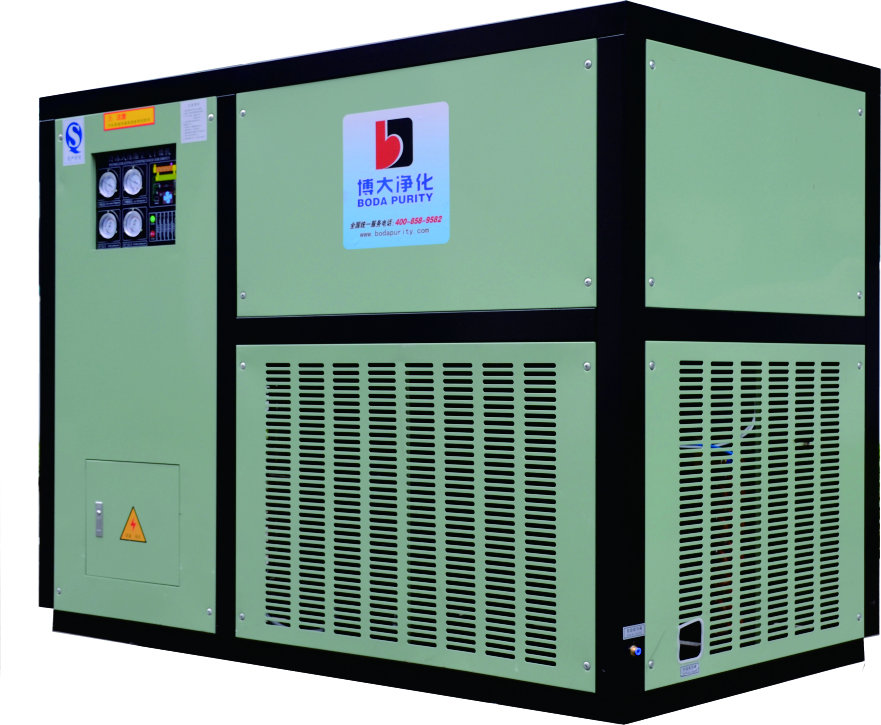
The FAD Series works on the refrigeration dehumidification principle: humid, hot compressed air is heat-exchanged in the evaporator, water vapour condenses into liquid water and is drained out through the air-water separator. Three configurations are available — air-cooled, water-cooled and high-temperature.
- Rated air treatment flow rate: 1–200 Nm³/min
- Working pressure: 0.6–0.8 MPa (0.8–3.0 MPa optional)
- Qualified air dew point: ≤ –23 °C (under ambient pressure)
- Inlet temperature: below 38 °C; the high-temperature version accepts below 80 °C
- Cooling: air cooling or water cooling; inlet water pressure 0.2–0.4 MPa; inlet water temperature ≤ 32 °C
- Pressure loss: ≤ 0.02 MPa
- Customization: stainless steel, ATEX, ASME, CE
Details that matter downstream include international-brand refrigeration compressor components (Denmark/Danfoss brand is the main refrigeration component), a plastic-sprayed air-flow passage that avoids secondary pollution of the compressed air, a gas-liquid separation design that prevents re-evaporation of drained water, and an electronic drainage system that is not easy to block. Optional RS485/RS232, linkage interface and dew point detection are available. The FAD Series is described as pre-treatment equipment for PSA nitrogen and oxygen generators, protecting molecular sieve from moisture damage, and is also applied to automated workshops, pneumatic cylinders, solenoid valves, spray-painting stations, beverage bottling, food packaging, grain conveying, pharmaceutical production and fiber-laser or plasma-cutting machines.
ADL Series heatless desiccant dryer — the –40 °C to –52 °C class
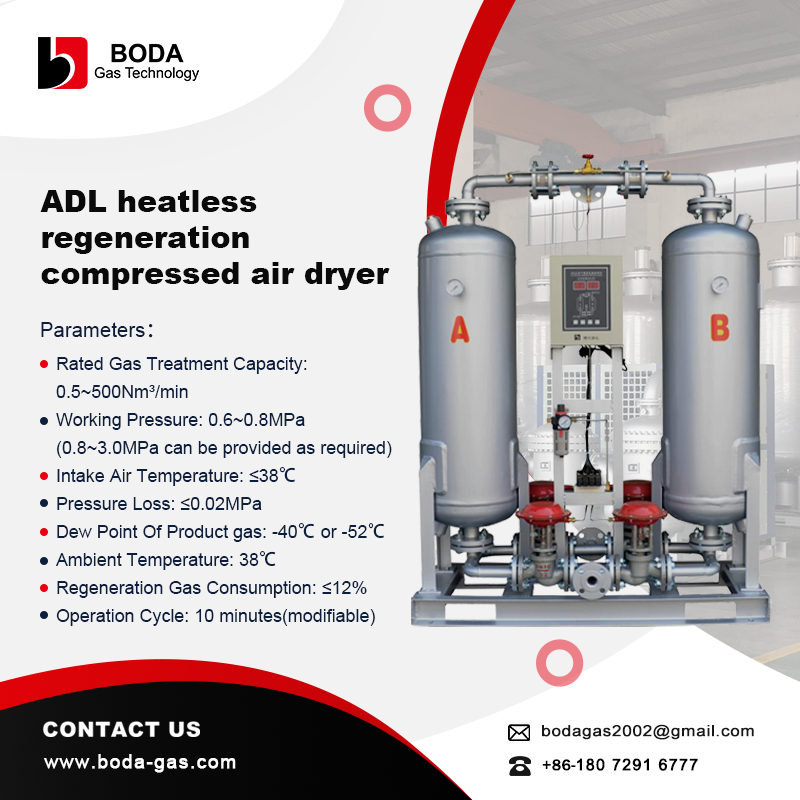
Heatless regeneration drying removes water from compressed air by pressure swing adsorption on microporous desiccant. The ADL Series is the configuration used where a –40 °C or –52 °C dew point class is required and heated regeneration is not justified by flow size.
- Rated air treatment flow rate: 0.5–500 Nm³/min
- Working pressure: 0.6–0.8 MPa (0.8–3.0 MPa optional)
- Qualified air dew point: ≤ –40 °C or ≤ –52 °C
- Inlet temperature: below 38 °C
- Regeneration air loss: ≤ 12%
- Pressure loss: ≤ 0.02 MPa
- Operating cycle: 10 minutes (modifiable)
- Customization: stainless steel, ATEX, ASME, CE
Control features include microcomputer control with LCD/LED display of operating status, multiple fault alarms and processing functions, online parameter modification and protection, and an optional online dew point control function using national patent technology to maximise energy saving. RS485/RS232 communication and joint control are optional. Application data lists pre-treatment for PSA nitrogen generators, PSA oxygen generators and high-purity gas purification plants, plus fiber-laser cutting, laser welding, precision metal machining, pharmaceutical manufacturing, hospital oxygen supply, PCB processing, lithium battery production, beverage bottling, plastic-bottle blow moulding and fine chemical processing.
ADH Series heated desiccant dryer — same dew point class, lower purge loss
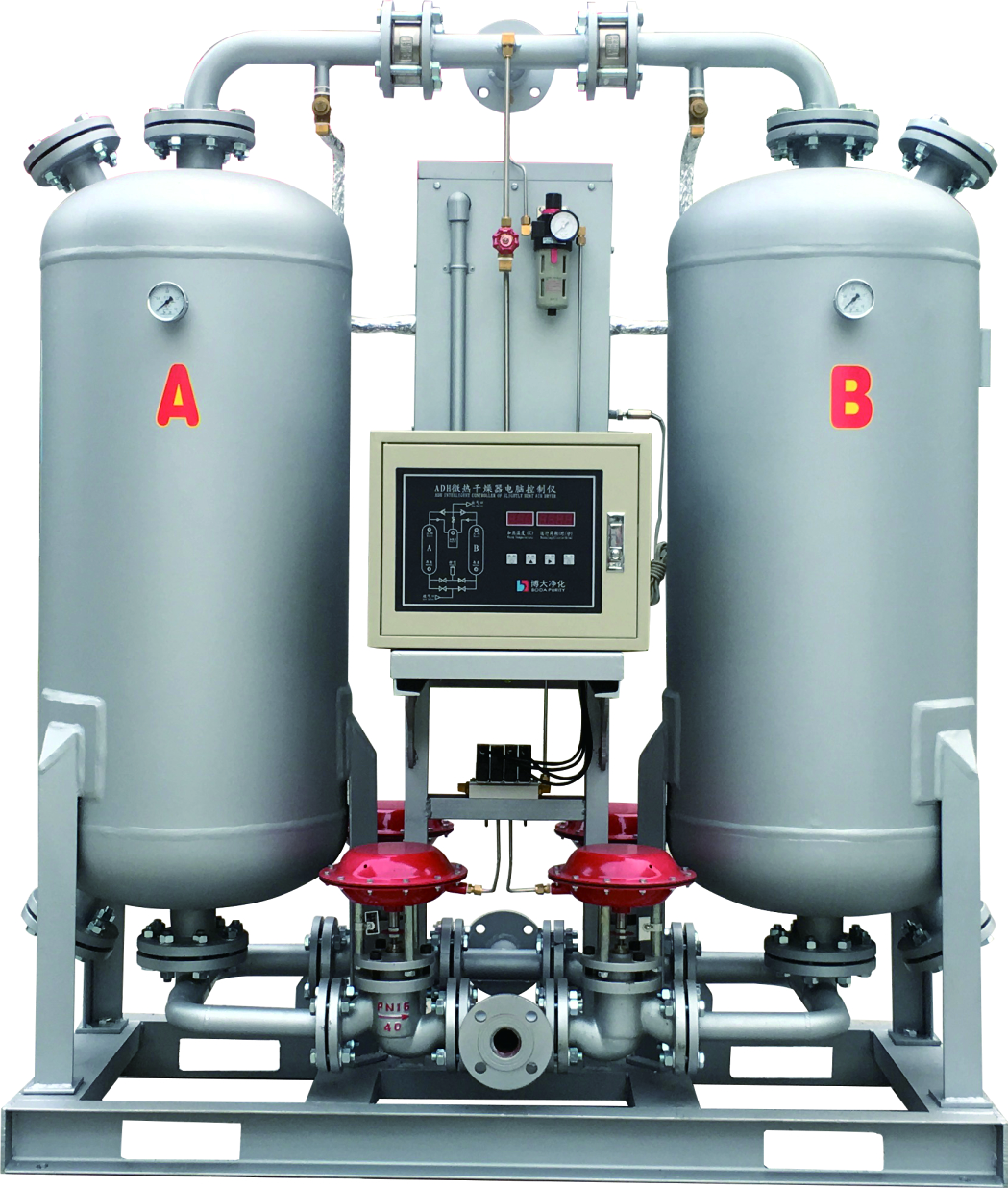
The ADH Series is a heated (low-heat regenerative) desiccant dryer developed by integrating the advantages of heated regeneration and heatless regeneration: purge air is heated before it regenerates the desiccant, which delivers better regeneration performance and lower purge-air consumption.
- Rated air treatment flow rate: 1–500 Nm³/min
- Working pressure: 0.6–0.8 MPa (0.8–3.0 MPa optional)
- Qualified air dew point: ≤ –40 °C or ≤ –52 °C
- Inlet temperature: below 38 °C
- Regeneration air loss: ≤ 6%
- Pressure loss: ≤ 0.02 MPa
- Ambient temperature: 38 °C
- Customization: stainless steel, ATEX, ASME, CE
Two national-patented features matter at selection stage. If the micro-heat operation mode fails, the dryer automatically converts to no-heat operation mode, so dew point function is preserved rather than lost. A re-energised heating safety protection device is also fitted. Heating control uses a non-contact solid-state switch with small temperature-control overshoot and long service life, and an online dew point control function is optionally available to maximise energy saving. The ADH Series is specified for pre-treatment of large-scale PSA nitrogen and oxygen generators, gas purification and cylinder-filling stations, central gas supply for multiple laser-cutting and automatic-welding stations, pharmaceutical aerobic fermentation, aseptic packaging lines, lithium battery workshops, photovoltaic wafer processing, semiconductor assembly, fine chemical reaction and powder-material pneumatic conveying.
FAG Series combined low dew point dryer — when –40 °C is not enough
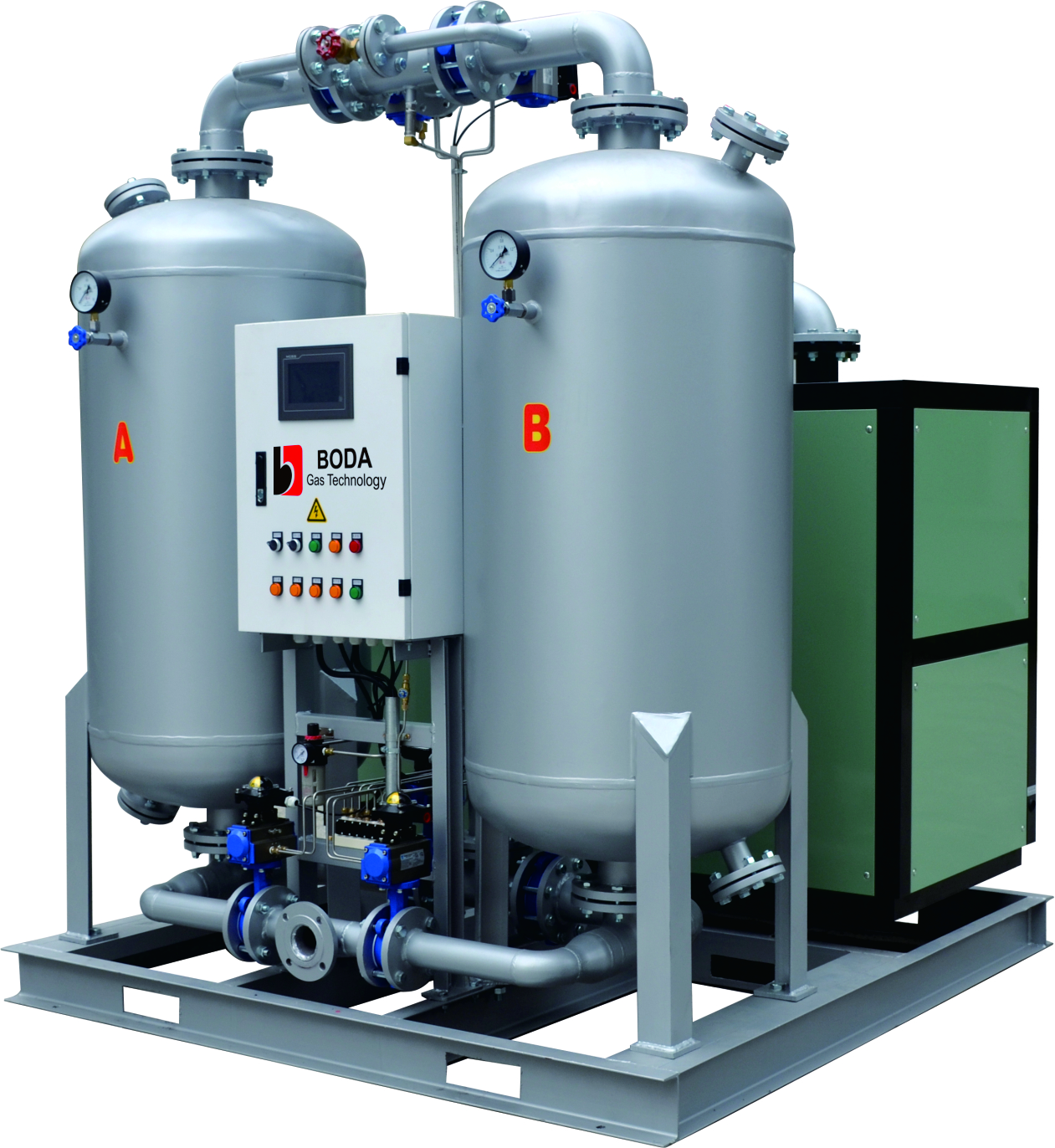
Where the end-use point demands a deeper dew point than the –40 °C / –52 °C class, the FAG Series combines a refrigerated dryer and an adsorption dryer in one integrated unit. It reaches a qualified air dew point of ≤ –60 °C to –70 °C with a rated air treatment flow rate of 1–300 Nm³/min, working pressure 0.6–0.8 MPa (0.8–3.0 MPa optional), inlet temperature below 38 °C and regeneration air loss of only 3–6%. Air-cooled and water-cooled versions are available, with inlet water pressure 0.2–0.4 MPa and inlet water temperature ≤ 32 °C.
The rest of the air-quality train
A dryer chosen correctly still cannot protect the CMS beds on its own. BODA GAS pre-treatment trains place mechanical separation and filtration around the dryer, and all of those components share the same flow and pressure window as the dryers they support:
- FYS Series high-efficiency oil-water separator — three-stage centrifugal, impact and gravity-settling separation with gas-liquid separation efficiency above 98%, 1–500 Nm³/min, pressure loss ≤ 0.02 MPa and no consumable filter element.
- FAL Series precision filter — gradient composite glass-fibre cartridge trapping dust, rust, fine water droplets and oil mist, 1–500 Nm³/min, pressure loss ≤ 0.02 MPa.
- FLY Series high-efficiency oil remover — cyclone separation plus coarse and fine filtration, filtration precision 0.1 μm and residual oil content below 0.01 mg/m³.
- FLT Series activated carbon filter — high-density column-shaped activated carbon granules with outlet residual oil content below 0.003 mg/m³ and an anti-powder-leakage baffle plate that keeps carbon dust out of the downstream dryer and molecular sieve.
- FLC Series sterilizing filter — for medical and aseptic duties: 0.1 μm filtering accuracy, 0–80 °C working temperature with 121 °C online steam sterilization, SS304 housing, suitable for air and nitrogen.
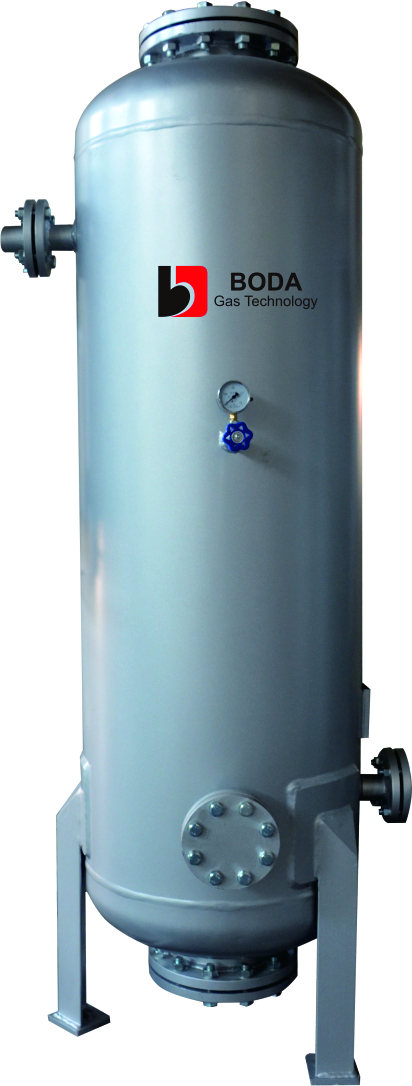
Step-by-Step: How to Size a PSA Nitrogen Pre-Treatment Dryer
- Fix the required dew point at the point of use, not at the dryer. Read it from both the process specification and the generator rating. A –23 °C class points to FAD; –40 °C or –52 °C points to ADL or ADH; –60 °C to –70 °C points to the FAG combined dryer.
- Fix the design flow in Nm³/min. The families cover different windows — ADL 0.5–500 Nm³/min, ADH 1–500 Nm³/min, FAD 1–200 Nm³/min and FAG 1–300 Nm³/min — and the rated flow must be read against the real consumption of the system, including regeneration purge air.
- Confirm working pressure. Standard working pressure across the range is 0.6–0.8 MPa. Where the project runs higher, an optional high-pressure version is available up to 3.0 MPa, and this also applies to the filter and separator components in the same train.
- Check inlet temperature and cooling medium. ADL, ADH, FAG and the standard FAD are quoted at inlet below 38 °C. If the compressor discharges hotter, the FAD high-temperature version is rated for inlet below 80 °C. Water-cooled equipment adds requirements of inlet water pressure 0.2–0.4 MPa and inlet water temperature no higher than 32 °C.
- Decide heatless or heated. ADL and ADH reach the same dew point class; the difference is regeneration air loss (≤ 12% versus ≤ 6%) plus the heated unit's automatic fallback to no-heat operation if the micro-heat mode fails. Large continuous flows usually justify the heated option on purge consumption alone.
- Specify materials, certification and instrumentation. Carbon steel or SS304; ATEX, ASME or CE where the market or the hazardous area requires it; optional online dew point control and RS485/RS232 communication for plants that will link the dryer into a control system.
- Plan the maintenance envelope before purchase. BODA GAS service guidance for a PSA nitrogen system is: precision filter element replacement every 8,000 hours; air compressor service including oil, oil filter and air/oil separator every 3,000 to 4,000 running hours; air dryer desiccant generally 16,000 to 24,000 hours; carbon molecular sieve 6 to 10 years.
Use Cases: Where Each Configuration Fits
Chemical plants
Chemical industry nitrogen applications are listed at 99.0% to 99.99% purity, for reactor inert shielding, raw-material tank blanketing for chemical stock, pipeline purging and conveying gas for powder chemicals, with explosion-proof and ASME certification as special requirements. This is the duty where the ADL and ADH desiccant dryers are normally specified in front of the CMS beds. Field evidence from the same duty: a chemical-industry installation in Malaysia has run 2 units of desiccant dryer equipment stably for more than 8 years with ASME compliance and low dew point operation, and an Indonesian chemical-industry installation has run 2 units for 7 years with ASME standard construction and stainless steel pipeline.
Food and beverage packaging
Food and beverage packaging is listed at 99.0% to 99.9% nitrogen purity with an oil-free air compressor and stainless steel construction as special requirements, covering modified atmosphere packaging, beverage production and tank blanketing. For food-grade nitrogen, EIGA standards require at least one continuously online residual oxygen analyzer in the nitrogen gas stream (EIGA, 2024) — a point worth writing into the dryer and generator instrumentation scope together. A food-processing installation in Mexico operates 2 units producing food-grade nitrogen and has run stably for 4 years.
Pharmaceutical production
Pharmaceutical use is listed at 99.99% to 99.999% nitrogen purity with oil-free and stainless steel requirements, for medicine packaging and to maintain a clean, sterile environment during drug production, storage, sealing and packaging. Terminal sterile filtration is handled by the FLC Series filter, and the dryer duty falls on the desiccant families because of the purity class involved.
Electronics and semiconductors
Electronics duty is where the dew point requirement becomes explicit: common SMT workshops are listed at 99.99% purity, while chip-and-wafer precision manufacturing is listed at 99.999% to 99.9999% purity with dew point ≤ –60 °C and an ultra-low-dew-point air-purification system as a special requirement. That is the point at which the FAG combined dryer enters the discussion. A Jordan electronics installation runs 2 units of PSA nitrogen generator with remote start-stop, dew-point readout and remote control functions, and has operated stably for 5 years with repeat purchases.
Oil, gas and pipeline duty
Petroleum industry applications are listed at 95% to 99.9% nitrogen purity for tank blanketing and nitrogen purging, pipeline and vessel purging and inerting, and well stimulation, pressure holding and well-bore flushing, with explosion-proof equipment for Zone 1 / Zone 2 hazardous-gas working areas as a special requirement. Field evidence: a Nigerian coal-chemical and electromechanical installation runs 2 units with a nitrogen output capacity of 3000 Nm³/h and has operated stably for 2 years. Where dryers are used for long-distance gas-transmission pipelines and oil-field commissioning rather than for a nitrogen generator, the PDL Series mobile pipeline-specific compressed air dryer is rated 1–300 Nm³/min at 0.6–1.6 MPa with a –40 °C dew point, inlet temperature below 120 °C and a portable dew point meter; a Ugandan EPC project installed 3 units for petroleum pipeline service with stable operation for 3 years, a mobile/portable design and low dew point capability.
Laser cutting, cable and other industrial duty
Laser and plasma cutting is listed at 95% to 99% nitrogen purity for ordinary carbon-steel cutting and 99.99% to 99.999% for mirror-finish stainless-steel fine-cutting with high-pressure nitrogen output. Cable manufacturing sits at the top of the purity range: an Uzbekistan installation runs 3 units with adjustable purity up to 99.999% and fully automatic unattended PLC operation, stable for 3 years.
Comparison Table: FAD, ADL, ADH and FAG Dryers
| Parameter | FAD Series (Refrigeration) | ADL Series (Heatless Desiccant) | ADH Series (Heated Desiccant) | FAG Series (Combined Low Dew Point) |
|---|---|---|---|---|
| Qualified air dew point | ≤ –23 °C (under ambient pressure) | ≤ –40 °C or ≤ –52 °C | ≤ –40 °C or ≤ –52 °C | ≤ –60 °C to –70 °C |
| Rated air treatment flow rate | 1–200 Nm³/min | 0.5–500 Nm³/min | 1–500 Nm³/min | 1–300 Nm³/min |
| Working pressure | 0.6–0.8 MPa (0.8–3.0 MPa optional) | 0.6–0.8 MPa (0.8–3.0 MPa optional) | 0.6–0.8 MPa (0.8–3.0 MPa optional) | 0.6–0.8 MPa (0.8–3.0 MPa optional) |
| Inlet temperature | Below 38 °C; high-temperature version below 80 °C | Below 38 °C | Below 38 °C | Below 38 °C |
| Regeneration air loss | Not applicable (refrigeration type) | ≤ 12% | ≤ 6% | 3–6% |
| Pressure loss | ≤ 0.02 MPa | ≤ 0.02 MPa | ≤ 0.02 MPa | Not stated in the same form; integrated refrigerated plus adsorption unit |
| Cooling / utilities | Air cooling or water cooling; inlet water 0.2–0.4 MPa, ≤ 32 °C | Not applicable | Not applicable | Air cooling or water cooling; inlet water 0.2–0.4 MPa, ≤ 32 °C |
| Control and options | Optional RS485/RS232, linkage interface, dew point detection | Optional online dew point control (national patent), RS485/RS232, joint control | Optional online dew point control (national patent), RS485/RS232; non-contact solid-state heating control; automatic fallback to no-heat mode | Microcomputer control with LCD/LED display; optional RS485/RS232, linkage interface and dew point detection |
| Material and customization | Carbon steel / SS304; stainless steel, ATEX, ASME, CE | Carbon steel / SS304; stainless steel, ATEX, ASME, CE | Carbon steel / SS304; stainless steel, ATEX, ASME, CE | Carbon steel / SS304; stainless steel, ATEX, ASME, CE |
| Typical role in a PSA nitrogen train | First-stage bulk moisture removal and general compressed-air protection | Direct protection of CMS beds where –40 °C / –52 °C class is required | Same protection class as ADL with lower continuous purge consumption | Ultra-low dew point duties such as wafer and precision electronics manufacturing |
| Pre-treatment component | Model | Key data | Function in the train |
|---|---|---|---|
| High-efficiency oil-water separator | FYS Series | 1–500 Nm³/min; gas-liquid separation efficiency above 98%; pressure loss ≤ 0.02 MPa; no consumable element | First stage — intercepts bulk liquid water and oil droplets |
| Precision filter | FAL Series | 1–500 Nm³/min; pressure loss ≤ 0.02 MPa; glass-fibre cartridge | Second stage — traps dust, rust, fine droplets and oil mist |
| High-efficiency oil remover | FLY Series | Residual oil below 0.01 mg/m³; filtration precision 0.1 μm | Protects molecular sieve from oil pollution |
| Activated carbon filter | FLT Series | Residual oil below 0.003 mg/m³; anti-powder-leakage baffle | Terminal oil and VOC removal before the dryer and beds |
| Air dryer | FAD / ADL / ADH / FAG | Dew point from ≤ –23 °C to ≤ –70 °C | Delivers the dew point class the process requires |
| Sterilizing filter | FLC Series | 0.1 μm accuracy; 0–80 °C, 121 °C steam sterilizable; SS304 | Terminal sterile filtration for medical, aseptic and food duty |
Frequently Asked Questions
1. Why does a PSA nitrogen generator need a dryer in the pre-treatment stage?
Because the carbon molecular sieve beds adsorb water as well as oxygen. BODA GAS service documentation states that adsorption of excess moisture reduces the adsorption performance of the molecular sieve to oxygen molecules, and that oil poisoning is one of the most important failure forms of oxygen-generator and nitrogen-generator adsorbents. A dryer is therefore placed in the pre-treatment train to remove the water load before the air reaches the beds. The dryness actually required is set by the end-use point — for example, chip-and-wafer precision manufacturing is listed at nitrogen purity of 99.999% to 99.9999% with dew point ≤ –60 °C, while a BXN Series PSA nitrogen generator is rated for nitrogen dew point of –40 °C to –70 °C.
2. What dew point can the FAD, ADL and ADH dryer series deliver?
They cover three different classes. FAD Series refrigeration dryers deliver qualified air dew point of ≤ –23 °C under ambient pressure. ADL Series heatless desiccant dryers and ADH Series heated desiccant dryers both deliver ≤ –40 °C or ≤ –52 °C. Where a deeper dew point is needed, the FAG Series combined low dew point dryer reaches ≤ –60 °C to –70 °C. All of these figures are quoted at specified inlet conditions — below 38 °C inlet temperature for the desiccant and combined dryers — so a site with a hotter compressor discharge will not reproduce them without additional cooling.
3. Which dryer configuration suits an industrial PSA nitrogen generator for a chemical plant?
Chemical industry nitrogen applications are listed at 99.0% to 99.99% purity, for reactor inert shielding, raw-material tank blanketing and pipeline purging with conveying gas for powder chemicals, with explosion-proof and ASME certification as special requirements. In that duty the ADL Series heatless or ADH Series heated desiccant dryers are the normal specification, because they reach the –40 °C / –52 °C dew point class directly in front of the CMS beds, with the heated version reducing regeneration air loss from ≤ 12% to ≤ 6%. Certification must be written into the order: ATEX, ASME and CE versions are available across the ADL, ADH and FAD Series. Comparable field evidence exists for the same duty — a chemical-industry installation in Malaysia has run 2 units stably for more than 8 years with ASME compliance and low dew point, and an Indonesian chemical-industry installation has run 2 units for 7 years with ASME standard construction and stainless steel pipeline.
4. What are the working limits — flow, pressure and inlet temperature?
The rated air treatment flow windows are 0.5–500 Nm³/min for the ADL Series, 1–500 Nm³/min for the ADH Series, 1–200 Nm³/min for the FAD Series and 1–300 Nm³/min for the FAG Series. Standard working pressure is 0.6–0.8 MPa across these ranges, with an optional high-pressure version up to 3.0 MPa. Inlet temperature limits are below 38 °C for the ADL, ADH and FAG Series, below 38 °C for the standard FAD Series and below 80 °C for the FAD high-temperature version. Water-cooled units require inlet water pressure of 0.2–0.4 MPa and inlet water temperature no higher than 32 °C. Pressure loss is ≤ 0.02 MPa across the range, which keeps compressor energy consumption under control during non-stop operation.
5. What is the lead time, minimum order quantity and next step for a pre-treatment dryer?
BODA GAS produces these dryers on an OEM and ODM basis with a minimum order quantity of one unit and a production lead time of 25 to 45 days; monthly capacity is 40 units, and every unit is 100% tested with visual inspection and function inspection before release. Customization covers flow rate, purity, pressure, dew point, material, production standard, voltage, logo, nameplate and painting colour, and equipment is supplied with a 12-month guarantee plus remote technical support, operation-staff training and on-site installation guidance. The practical next step is to share the nitrogen flow, required purity and dew point, working pressure, inlet temperature and site voltage with the BODA GAS team — email bodagas2002@gmail.com or message +86 157-5515-0162 on WhatsApp — and request the product manual for the complete specification set.
Conclusion
The dew point decision in PSA nitrogen pre-treatment comes down to four inputs: the dew point the process needs, the Nm³/min of air to be treated, the working pressure, and the inlet temperature. Once those are fixed, the choice between a FAD Series refrigeration dryer at ≤ –23 °C, an ADL Series heatless or ADH Series heated desiccant dryer at ≤ –40 °C or ≤ –52 °C, and a FAG Series combined dryer at ≤ –60 °C to –70 °C follows directly. What remains is commercial rather than technical: regeneration air loss (≤ 12% versus ≤ 6%), material and certification (carbon steel or SS304, ATEX, ASME, CE), instrumentation (online dew point control, RS485/RS232), and the maintenance envelope that keeps the molecular sieve protected for its 6 to 10 year service life.
BODA GAS — Hangzhou Boda Purity Equipment Co., Ltd. — has manufactured PSA nitrogen generators, PSA oxygen generators and compressed air purification equipment since 2002 from a 30,000 m² production base in Hangzhou, Zhejiang Province, with 15 R&D engineers, 58 employees and an annual output of 480 units; approximately 30% of production is exported. The company holds ISO 9001, ISO 13485, ISO 14001 and ISO 45001 system certifications. More information is available at boda-gas.com.
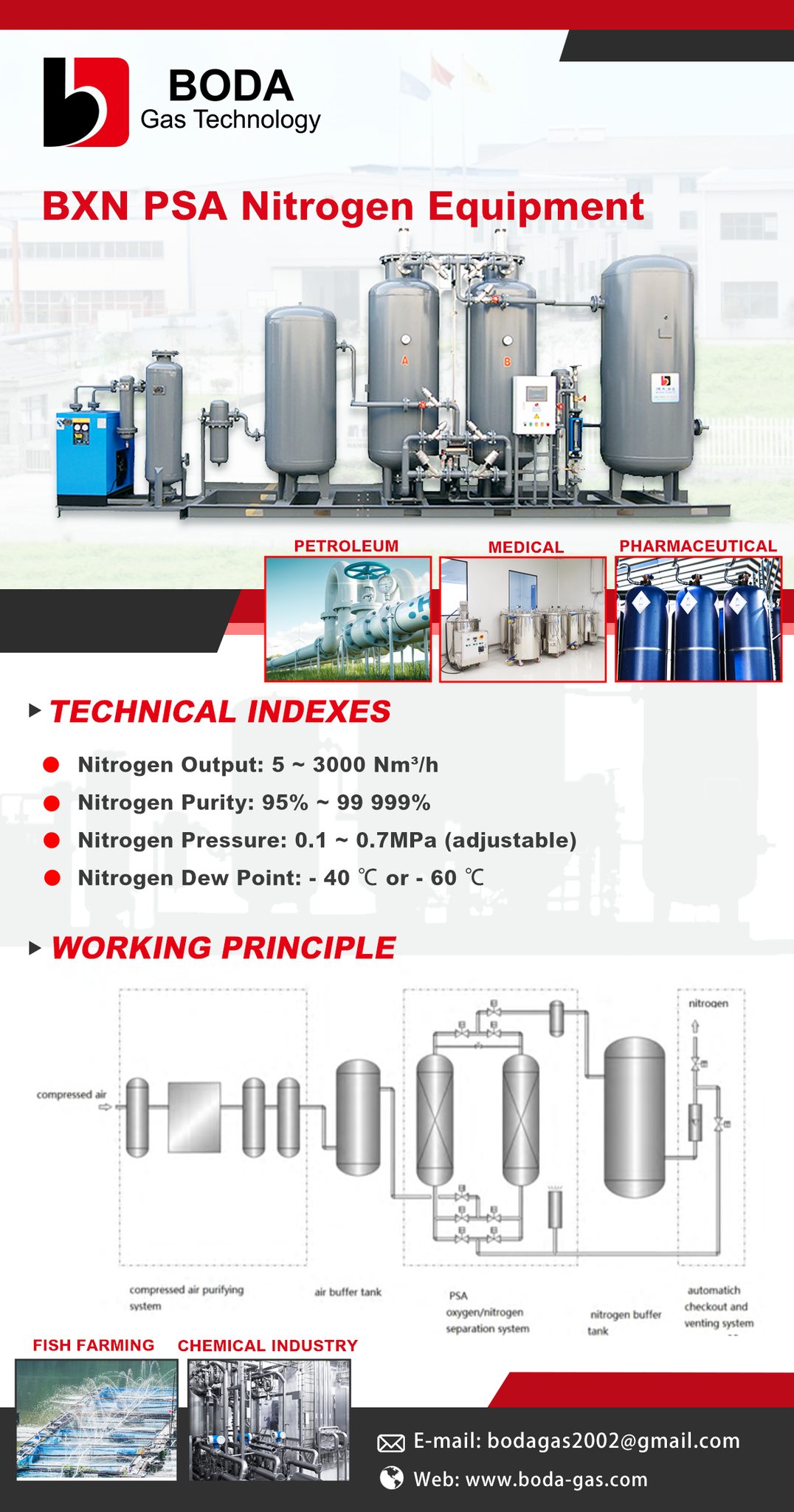
Next step: send your nitrogen flow (Nm³/h), required purity and dew point, working pressure, inlet temperature and site voltage, and BODA GAS will confirm the correct dryer series and configuration for your project. Request the full specification set in the downloadable product manual: BODA GAS Product Manual (PDF).
Email: bodagas2002@gmail.com | Tel / WhatsApp: +86 157-5515-0162 | Website: www.boda-gas.com
Have Questions or Need More Details?
Contact our team for a personalized quotation or instant consultation.
Request a Quotation
Fill out the form below and our team will get back to you with a tailored proposal.
WhatsApp Direct Chat
Prefer to chat in real-time? Message us on WhatsApp for instant assistance & quick answers.
- Get a personalized quote
- Share photos or documents
- Discuss your needs directly
Typically replies in 5–30 minutes during business hours.