
PSA Nitrogen Generator Supplier Audit: Pre-Treatment Integration and Delivery
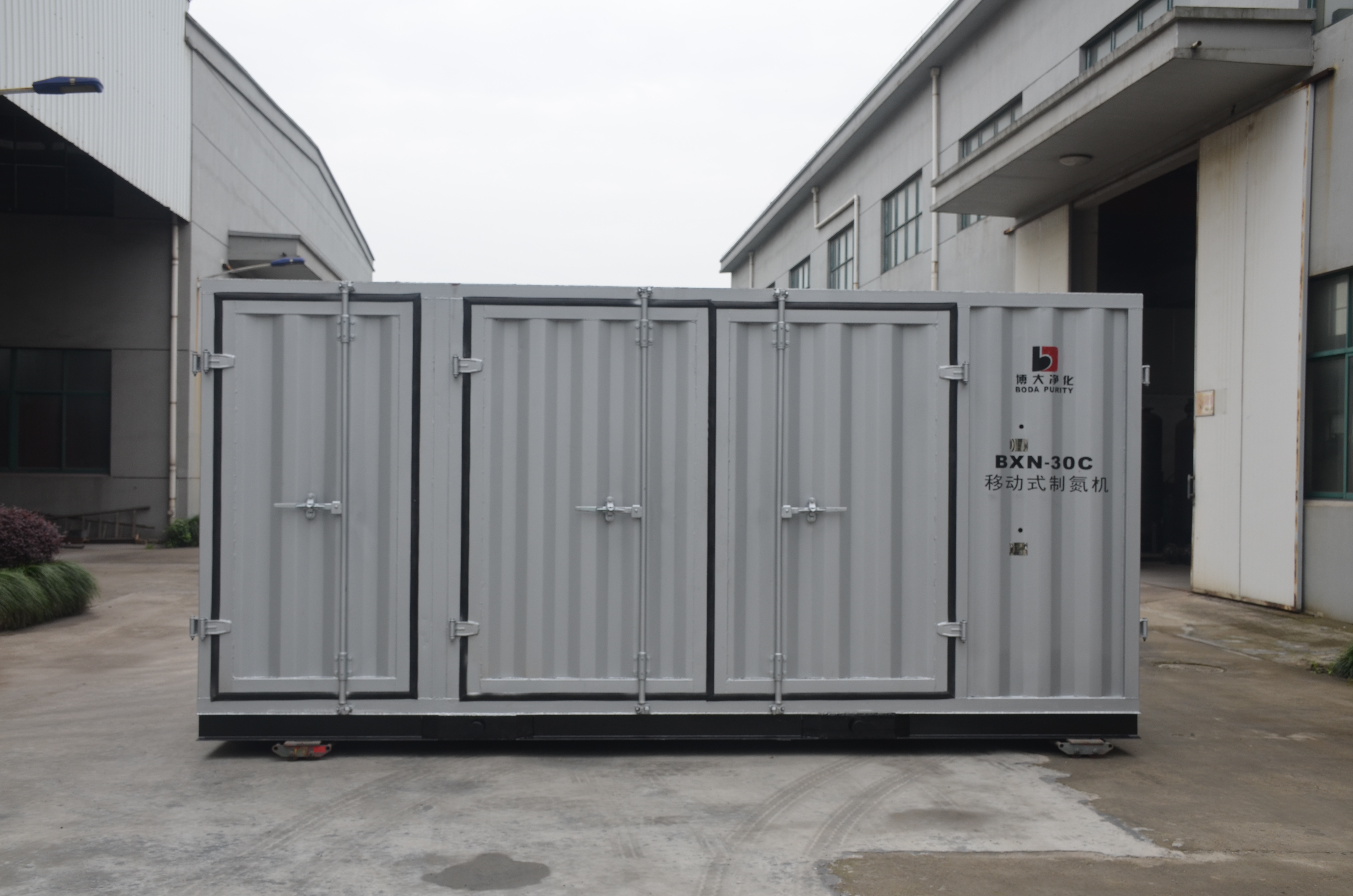
Integrated skid-in-container PSA nitrogen generator package — pre-treatment chain and adsorption unit shipped as one delivery item.
A PSA nitrogen generator is only as reliable as the air that reaches its carbon molecular sieve. That single fact reshapes how a supplier should be audited. Nitrogen flow, purity, outlet pressure and dew point are outputs; the filtration and drying stages in front of the adsorption towers decide whether those outputs still hold in month twelve, not just on commissioning day.
A complete supplier audit therefore covers three layers. First, pre-treatment integration: can the supplier supply, size and match every stage from bulk oil-water separation through to the final desiccant dryer? Second, purchasing terms: are acceptance criteria, tolerances and documentation defined in writing? Third, delivery assurance: is factory testing documented, is the package configured for transport and lifting, and is commissioning support specified? This guide turns those three layers into a working checklist for industrial PSA nitrogen generator projects.
The Real Risk Sits at the Boundary Between Components
Most audit checklists stop at the generator nameplate. That is not enough, because four common failure modes sit outside the adsorption unit itself.
- Oil vapour reaching the sieve. Oil poisoning is one of the most important failure forms of oxygen generator and nitrogen generator adsorbents. If residual oil in the compressed air is not held at the specified level, carbon molecular sieve performance degrades and purity drifts.
- Moisture. The adsorption stage cannot compensate for a drying stage that was never specified to the duty. Where the required outlet dew point is deep, the dryer selection must be made first, not added afterwards.
- Pressure loss stacking. In BODA GAS filter and dryer specifications, each stage is designed for a pressure loss of ≤0.02 MPa. Several stages in series accumulate, and a quotation that lists five components without totalling their pressure loss leaves the generator receiving less pressure than the design point.
- Split scope. When the generator comes from one vendor, the dryers from a second and the filters from a third, compatibility becomes the buyer's problem. The most common trap is a unit-of-measure mismatch: filters and dryers are rated in Nm³/min of air treatment, while the generator is rated in Nm³/h of nitrogen output.
An audit that ignores these boundaries approves a system on paper that cannot repeat its test result in the field.
Why Integration Capability Became the Deciding Audit Question
The commercial context explains why this audit matters more now than a decade ago. The global industrial nitrogen generator market was valued at USD 4.29 billion in 2023 and is projected to reach USD 6.47 billion by 2031 (Verified Market Research). Pressure swing adsorption accounts for approximately 48% of the global nitrogen generator market share, making it the dominant technology segment (Fortune Business Insights). Food and beverage alone held roughly 49.8% of 2023 revenue share, driven by modified atmosphere packaging (Grand View Research).
Capacity data points in the same direction for pre-treatment design. Installations divide into sub-100 Nm³/h (42%), 100–500 Nm³/h (36%) and above 500 Nm³/h (22%) (Precedence Research / Dataintelo). Asia-Pacific is projected to hold a 35% regional share by 2032 (Verified Market Research). Market-size estimates vary by scope across research houses, so any single figure should be treated as directional rather than exact. Key global players include Linde plc, Air Liquide, Air Products, Atlas Copco and Parker Hannifin (Fortune Business Insights).
Alongside those groups, a large share of project work is delivered by specialist manufacturers who build the purification chain and the generator as one package — precisely the capability this audit tests. Hangzhou Boda Purity Equipment Co., Ltd. (BODA GAS) is one example of that model. Headquartered in Hangzhou, Zhejiang Province, China, the company was established in 2002 and develops and manufactures PSA nitrogen generators, PSA oxygen generators and compressed air purification equipment, including refrigeration dryers, heatless and heated desiccant dryers, combined low dew point dryers and filters. It operates a 30,000 m² production base with 15 R&D engineers, approximately 58 employees and an annual output of 480 units; export business accounts for 30% of sales. Whether or not a buyer shortlists BODA GAS, the structure of its catalogue is a useful benchmark for what "integrated" should mean in a supplier's answer.
What an Integrated Pre-Treatment Train Actually Contains
An on-site PSA nitrogen generator system is normally delivered as: air compressor – receiver tank – multiple filters – air dryer – activated carbon filter – PSA nitrogen generator – nitrogen buffer tank – oxygen analyser / purity sensor – control system. The audit question is which of those blocks the supplier owns, specifies and matches.
Stage 1–2: bulk separation and particulate protection
The FYS Series high efficiency oil-water separator is the front-end unit, using three-stage centrifugal, impact and gravity-settling separation with a gas-liquid separation efficiency above 98%. It is rated for 1~500 Nm³/min at 0.6~0.8 MPa working pressure (0.8~3.0 MPa optional), inlet temperature below 50°C and pressure loss ≤0.02 MPa, and because it separates physically it has no consumable filter element.
The FAL Series precision filter follows as second-stage pre-treatment. Its gradient composite glass-fibre cartridge traps dust, rust, fine water droplets and oil mist, and it protects the downstream oil-remover, activated-carbon filter, dryer and PSA gas generator. Rated flow is 1~500 Nm³/min, working pressure 0.6~0.8 MPa (0.8~3.0 MPa optional), inlet temperature below 50°C and pressure loss ≤0.02 MPa, with a corrosion-resistant, quick-opening housing.
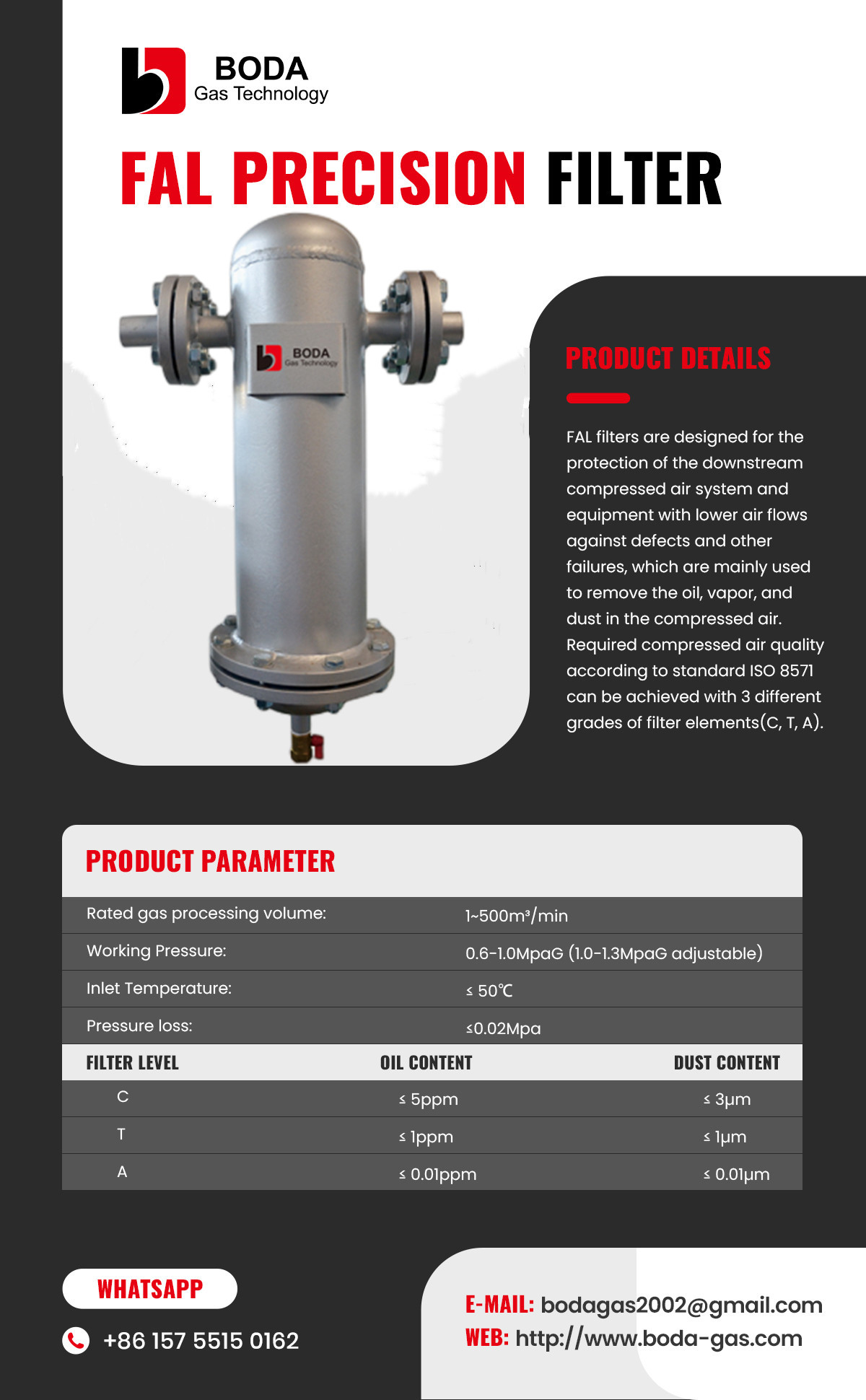
FAL Series precision filter — particulate protection ahead of the oil-remover, carbon filter, dryer and PSA unit.
Stage 3: oil vapour removal
Two stages matter here. The FLY Series high efficiency oil-remover combines cyclone separation, coarse filtration and fine filtration, achieving a filtration precision of 0.1 μm with residual oil below 0.01 mg/m³. The FLT Series activated carbon filter then brings outlet residual oil below 0.003 mg/m³ using high-density column-shaped activated-carbon granules, multi-layer graded filling that avoids air-flow short-circuiting, and an anti-powder-leakage baffle plate that keeps carbon dust out of the downstream dryer and molecular sieve.
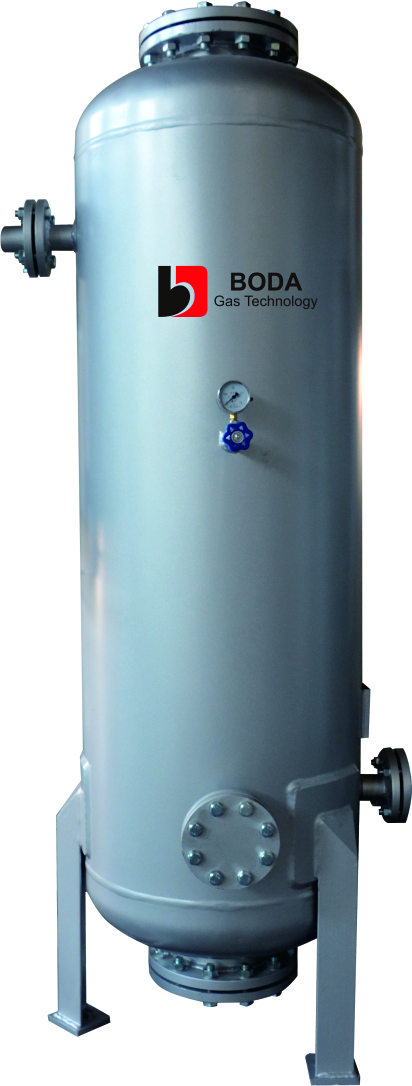
FLT Series activated carbon filter — final oil-vapour barrier before the adsorption towers.
Terminal sterile filtration, where the application requires it
The FLC Series sterilizing filter is a terminal stage for hospital oxygen supply, biopharmaceutical aseptic workshops and aseptic beverage or food nitrogen-filled packaging. It achieves 0.1 μm filtration accuracy, supports 121°C online steam sterilization for repeated use, is built in SS304 with a hydrophobic microporous cartridge, and is applicable to both air and nitrogen. Buyers running pharmaceutical or food-grade nitrogen should treat this stage as non-optional.
Drying: four options, four dew points
Drying is where the audit most often finds a mismatch, because the dryer is frequently chosen on price rather than on required dew point and regeneration cost.
- FAD Series refrigeration dryer. Air-cooling, water-cooling and high-temperature models, rated 1~200 Nm³/min at 0.6~0.8 MPa (0.8~3.0 MPa optional), with a qualified air dew point of ≤-23°C. The standard inlet limit is below 38°C; the high-temperature model accepts inlet air below 80°C. Main refrigeration components are Danfoss brand, with electronic drainage.
- ADL Series heatless desiccant dryer. Rated 0.5~500 Nm³/min, qualified air dew point ≤-40°C or ≤-52°C, inlet temperature below 38°C, regeneration air loss ≤12%, and a standard 10-minute operating cycle that can be modified.
- ADH Series heated desiccant dryer. Rated 1~500 Nm³/min with the same ≤-40°C or ≤-52°C dew point, but regeneration air loss of ≤6%. Heating control uses a non-contact solid state switch, and the unit can automatically convert from micro-heat to no-heat operation if micro-heat mode fails, using patented technology.
- FAG Series combined low dew point dryer. An integrated refrigerated plus adsorption unit rated 1~300 Nm³/min, with a qualified air dew point of ≤-60°C to -70°C and regeneration air loss of 3~6%. This is the stage ultra-high-purity nitrogen projects should be specifying.
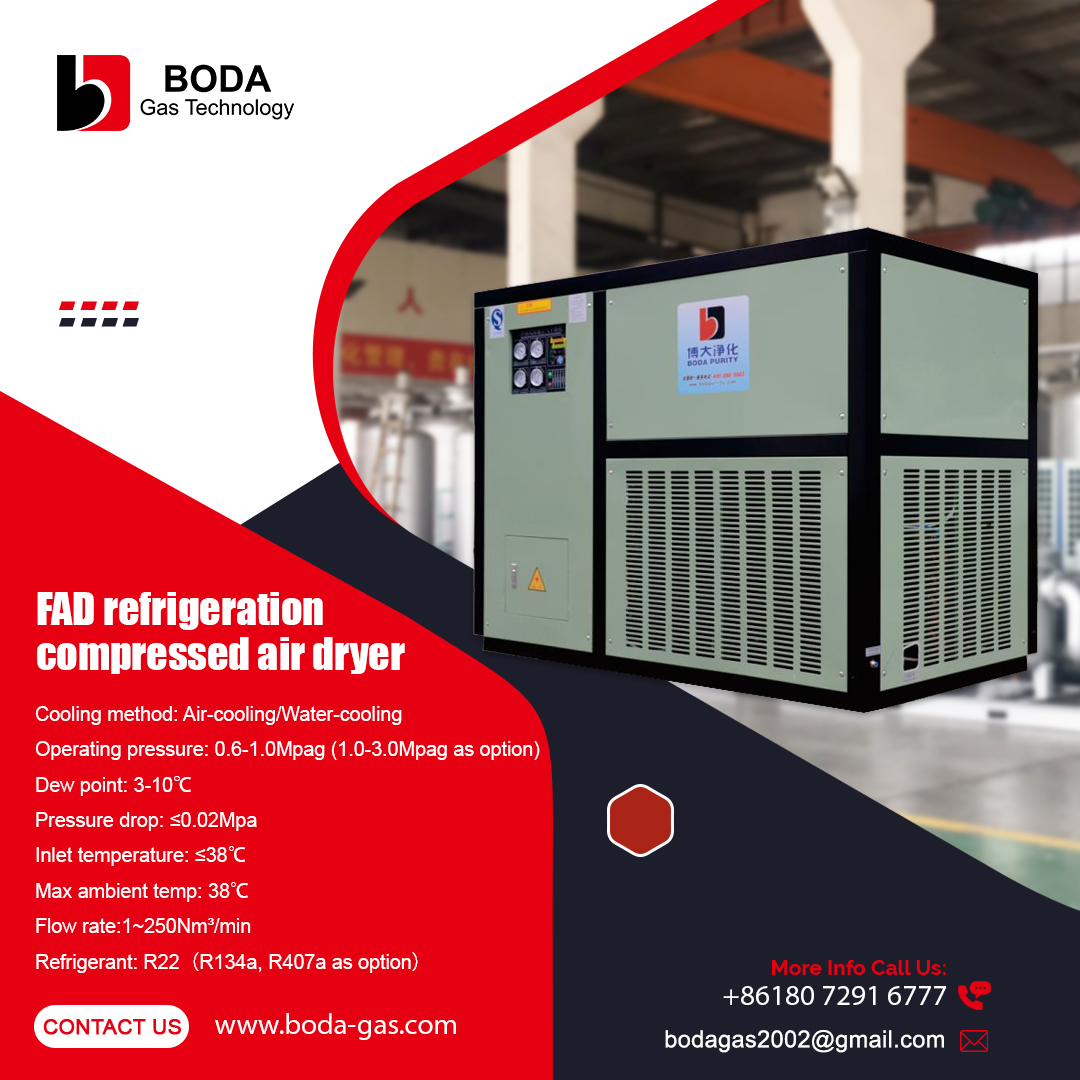
FAD Series refrigeration dryer — primary drying at a qualified dew point of ≤-23°C, in air-cooling, water-cooling or high-temperature configuration.
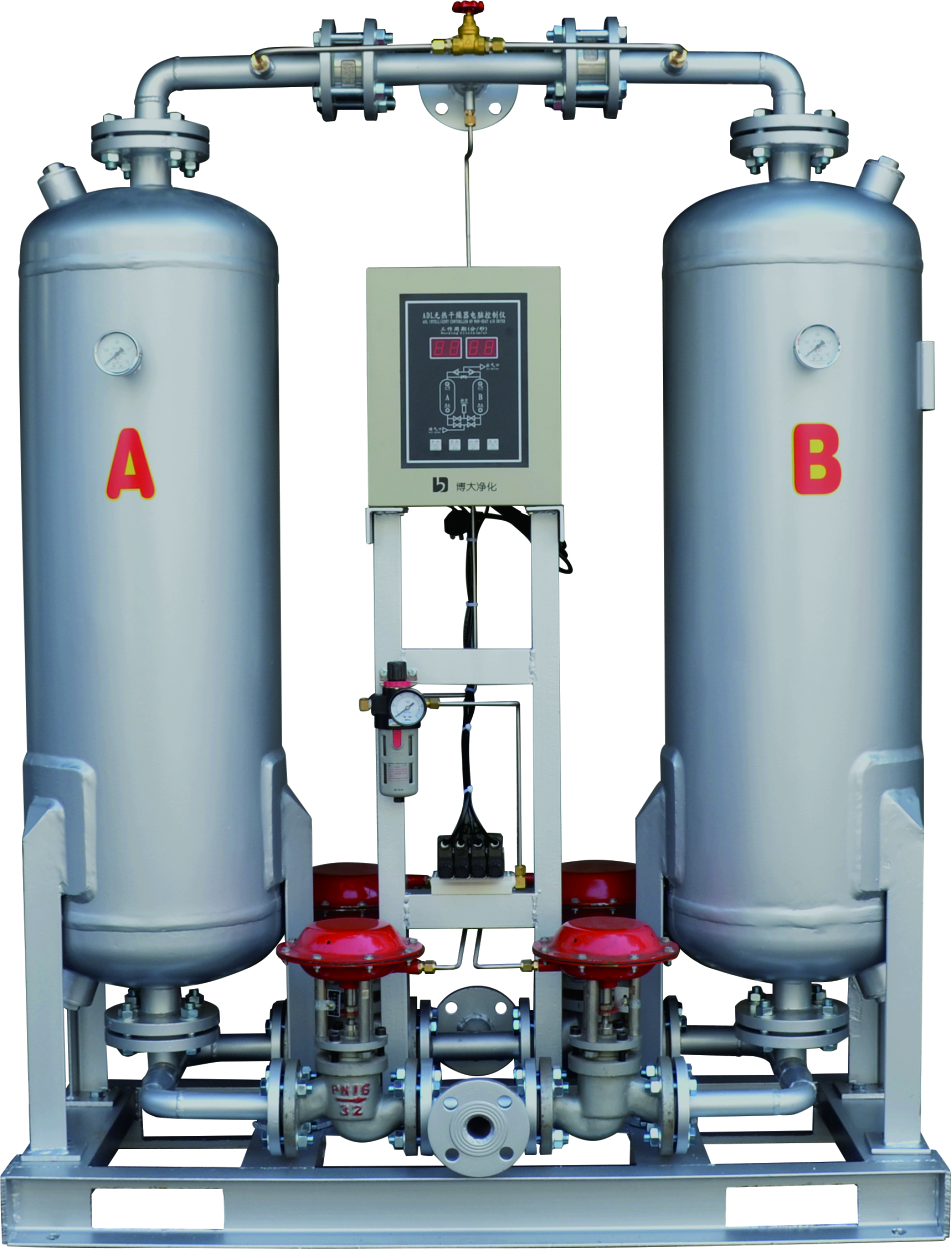
ADL Series heatless desiccant dryer — qualified dew point ≤-40°C or ≤-52°C with regeneration air loss ≤12%.
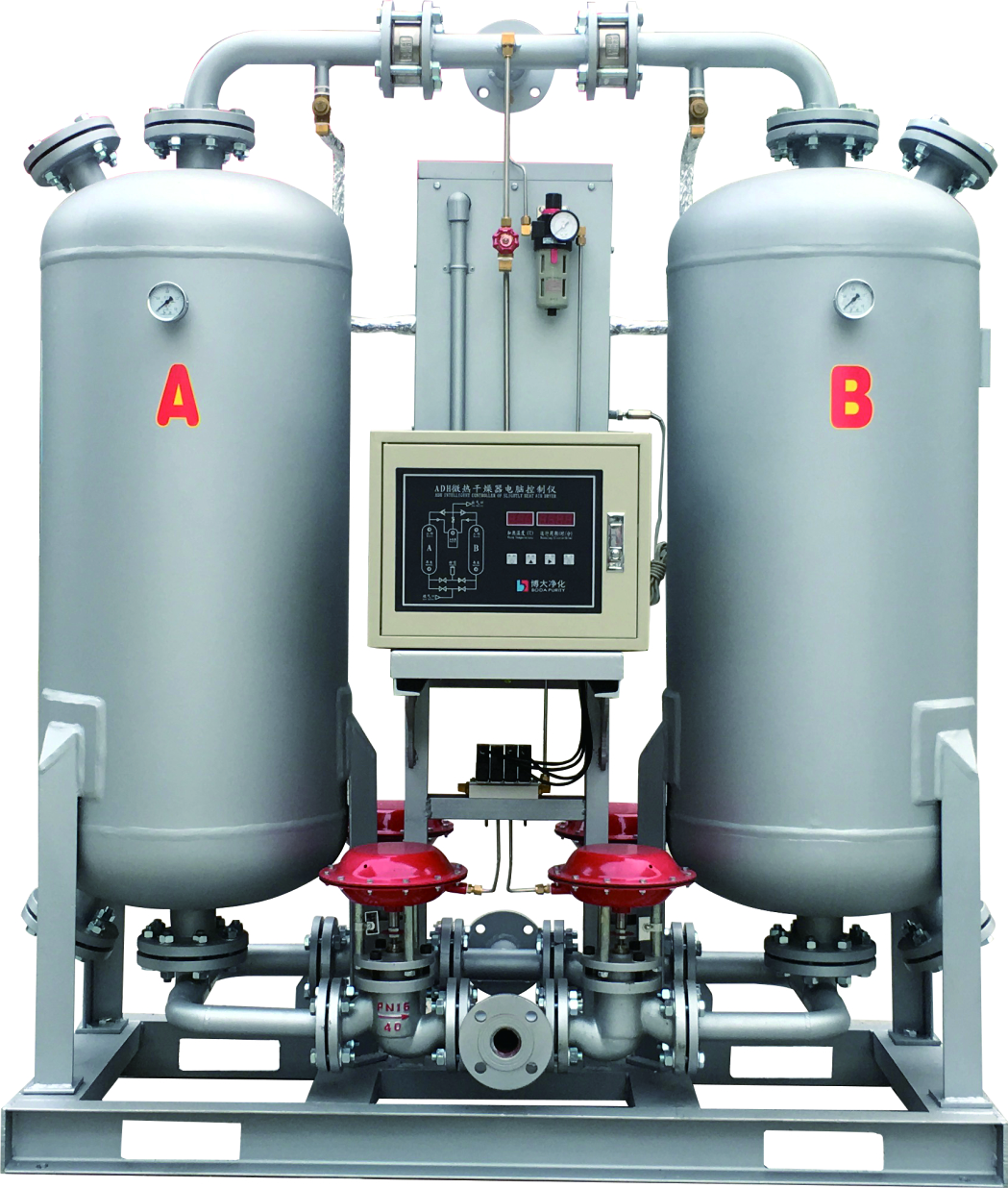
ADH Series heated desiccant dryer — the same dew point band as the heatless unit, with regeneration air loss reduced to ≤6%.
The generator itself
The BXN Series PSA nitrogen generator covers a nitrogen flow rate of 1~3000 Nm³/h at 95%~99.999% purity, with outlet pressure adjustable between 0.1 and 1.15 MPa, dew point from -40°C to -70°C and a noise level of 65~85 dB(A). It is available in carbon steel or SS304 construction and can be configured as an industrial PSA nitrogen generator, a skid-mounted PSA nitrogen generation package or a movable containerized PSA nitrogen generator, with ATEX, ASME, CE and ISO customization options.
Compatibility checks that decide whether the package works
- Flow units. 1 Nm³/min equals 60 Nm³/h. A filter or dryer rated 1~500 Nm³/min of air treatment covers 60~30,000 Nm³/h of air — far above the generator's nitrogen output range, because only part of the air becomes product nitrogen. Ask the supplier to state the air-to-nitrogen relationship, not just the filter rating.
- Cumulative pressure loss. Add every stage. With several stages each at ≤0.02 MPa, the accumulated allowance is a design decision, not a footnote.
- Inlet temperature. Filters are rated below 50°C (the FLC sterilizing filter to 80°C, and 121°C under steam); dryers are rated below 38°C, except the high-temperature FAD variant at below 80°C. If the compressor discharges hot air, the dryer model changes.
- Material and certification. Carbon steel versus SS304 has direct consequences for food, pharmaceutical and medical duty, and the same applies to ATEX, ASME and CE customization.
- Dew point against purity. Ultra-high-purity systems in the same catalogue operate at ≥99.9995% purity with a dew point ≤-60°C. If the buyer's target purity sits at the top of the BXN range, the drying stage must reach the matching dew point before the generator is priced.
A Seven-Step Supplier Audit Checklist
The checklist below converts the components above into questions a buyer can send to any supplier, including Chinese PSA nitrogen generator suppliers, and compare answers side by side.
- Fix the duty point before asking for a price. Provide nitrogen flow rate, purity, discharge pressure, voltage and frequency, application and site altitude. BODA GAS's own selection sheet requests exactly these inputs. Purity bands used across the industry are 95–98% for fire protection, marine tank blanketing, oilfield pipeline purging and general tyre inflation; 99–99.9% for food and beverage modified atmosphere packaging, winemaking and conventional plastic moulding; 99.95–99.99% for mild-steel laser cutting, electronics, cable production and pharmaceutical tank blanketing; and 99.999% and above for titanium alloy cutting, high-end electronics and specialised laboratory work.
- Request the full component list in sequence. Compressor, receiver tank, filters, dryer, activated carbon filter, PSA generator, buffer tank, oxygen analyser and control system. A supplier that quotes only the tower set has not quoted a system.
- Verify flow and pressure across each boundary. Confirm the air-treatment rating of every filter and dryer against the air demand of the generator, and total the pressure loss.
- Verify temperature and material compatibility. Match the dryer model to the actual compressor discharge temperature, and match wetted materials to the application.
- Agree acceptance criteria in the purchase terms. Specify purity, flow at the stated pressure, outlet dew point, allowable pressure loss, noise level and the measurement method for each. For food-grade nitrogen, European Industrial Gases Association guidance requires at least one continuously online residual oxygen analyser in the nitrogen stream. For EU projects, pressure vessels must comply with the Pressure Equipment Directive (PED 2014/68/EU) and bear the CE mark.
- Confirm what documentation proves quality. All equipment should pass qualification testing before factory release, with the test record attached. BODA GAS holds ISO 9001, ISO 13485, ISO 14001 and ISO 45001 system certifications and owns multiple invention patents and dozens of utility model patents. Ask also about component brand selection and coating thickness, and about carbon molecular sieve grade — high-density domestic sieve is typically rated 5–7 years, while imported anti-pulverisation sieve with special layered filling is described as holding stable purity over 8–10 years of non-stop running.
- Confirm delivery, packaging and commissioning. Establish whether the unit ships as a skid-mounted package or a movable containerized system, what the lifting and transport plan is, and who commissions it on site. Skid-mounted units are designed for plug-and-play operation after the power cable is connected, with minimal installation work; BODA GAS supplies 24-hour online after-sales support, operation manuals and video guidance, and can deploy overseas resident engineers for on-site installation, commissioning and maintenance.
Lifecycle figures to request alongside the quotation. Precision filter elements are typically replaced around every 8,000 running hours; air compressor service intervals fall at 3,000–4,000 running hours; air dryer desiccant is generally replaced at 16,000–24,000 hours; carbon molecular sieve is expected to last 6–10 years. A supplier that can quote these intervals has maintenance data; a supplier that cannot has a sales sheet.
How the Audit Changes by Application
Pre-treatment requirements shift with the process, so the same audit produces different pass marks. The nitrogen purity bands below follow BODA GAS published application conditions.
- Chemical industry (99.0–99.99%). Reactor inert shielding, raw-material tank blanketing and pipeline purging. Explosion-proof construction and ASME are listed as special requirements, which moves the audit toward certification and pressure-vessel documentation.
- Food and beverage packaging (99.0–99.9%, food-grade oil-free nitrogen). Modified atmosphere packaging, beverage production and tank blanketing. Confirm an oil-free air supply, stainless steel wetted parts and an online residual oxygen analyser.
- Pharmaceutical industry (99.99–99.999%). Drug production, storage, sealing and packaging. Oil-free and stainless steel construction are listed requirements, and terminal sterile filtration through the FLC Series becomes part of the scope.
- Oil and gas (95–99.9%). Tank blanketing, pipeline and vessel purging, well stimulation and pressure testing. The listed requirement is an explosion-proof PSA nitrogen generator for Zone 1 / Zone 2 hazardous-gas areas, plus containerized packaging for remote sites.
- Electronics (99.99%, up to 99.999%, dew point ≤-60°C). Semiconductor fabrication and packaging, LED and LCD production, and lithium-ion battery manufacturing. The specified special requirement is an ultra-low-dew-point air purification system, which pushes the choice toward a combined dryer.
- Laser and plasma cutting (95–99%, or 99.99–99.999% for mirror-finish stainless). High-pressure nitrogen acts as the auxiliary cutting gas; the listed special requirement is a matched high-pressure nitrogen booster set.
- Tyre inflation (95–98%). Compact, fast-inflation nitrogen generators using the standard compressor–tank–dryer–filter train plus a buffer tank.
Comparison Table: Pre-Treatment Components and Audit Checkpoints
Every row below is drawn from BODA GAS product specifications. The final column states what to verify in the audit rather than what to assume.
| Stage | Model | Rated flow | Verified parameter | Audit checkpoint |
|---|---|---|---|---|
| Bulk oil and water removal | FYS Series | 1~500 Nm³/min | Gas-liquid separation efficiency >98%; pressure loss ≤0.02 MPa | Confirm placement first in line; ask whether the automatic drain valve is included |
| Particulate protection | FAL Series | 1~500 Nm³/min | Inlet temperature <50°C; pressure loss ≤0.02 MPa; carbon steel / SS304 | Confirm it is specified as second-stage pre-treatment ahead of oil-remover, carbon filter, dryer and PSA unit |
| Oil vapour removal (primary) | FLY Series | 1~500 Nm³/min | Filtration accuracy 0.1 μm; residual oil <0.01 mg/m³ | Compare against the actual oil carryover of the compressor in use |
| Oil vapour removal (final) | FLT Series | 1~500 Nm³/min | Outlet residual oil <0.003 mg/m³; pressure loss ≤0.02 MPa | Confirm granular carbon replacement cost and the anti-powder-leakage baffle design |
| Terminal sterile filtration | FLC Series | 1~500 Nm³/min | 0.1 μm accuracy; 121°C steam sterilisation; SS304; air and nitrogen | Required for pharmaceutical, medical gas and aseptic food duty |
| Primary drying | FAD Series | 1~200 Nm³/min | Dew point ≤-23°C; inlet <38°C, or <80°C for the high-temperature model | Match the model to the real compressor discharge temperature |
| Deep drying (heatless) | ADL Series | 0.5~500 Nm³/min | Dew point ≤-40°C or ≤-52°C; regeneration air loss ≤12%; 10-minute cycle | Confirm the purge-air allowance is reflected in the compressor sizing |
| Deep drying (heated) | ADH Series | 1~500 Nm³/min | Dew point ≤-40°C or ≤-52°C; regeneration air loss ≤6% | Confirm heater power supply and the automatic micro-heat to no-heat fallback |
| Ultra-low dew point | FAG Series | 1~300 Nm³/min | Dew point ≤-60°C to -70°C; regeneration air loss 3~6% | Confirm whether one combined unit replaces a two-stage drying arrangement |
| Nitrogen generation | BXN Series | 1~3000 Nm³/h | Purity 95%~99.999%; pressure 0.1~1.15 MPa; dew point -40°C to -70°C; noise 65~85 dB(A) | Confirm the duty point, the factory test record and the skid or container configuration |
Two further comparisons are worth making inside the audit, because they affect both performance and running cost.
| Dryer type | Qualified dew point | Regeneration air loss | Where it fits |
|---|---|---|---|
| FAD Series refrigeration dryer | ≤-23°C | Not applicable (refrigerated) | First drying stage for general industrial duty |
| ADL Series heatless desiccant dryer | ≤-40°C or ≤-52°C | ≤12% | Deep drying where a heater power supply is impractical |
| ADH Series heated desiccant dryer | ≤-40°C or ≤-52°C | ≤6% | Deep drying where purge-air cost is the constraint |
| FAG Series combined low dew point dryer | ≤-60°C to -70°C | 3~6% | Ultra-high-purity and low-dew-point processes |
FAQ
Which certifications and standards should a PSA nitrogen generator supplier document?
For EU projects, pressure vessels inside a PSA nitrogen generator must comply with the Pressure Equipment Directive (PED 2014/68/EU) and bear the CE mark. For food-grade nitrogen, European Industrial Gases Association guidance requires at least one continuously online residual oxygen analyser in the nitrogen gas stream. BODA GAS equipment can be supplied with stainless steel, ATEX, ASME, CE and ISO customization, and the company holds ISO 9001, ISO 13485, ISO 14001 and ISO 45001 system certifications. The audit point is scope: ask which certificate covers which component, and attach that list to the purchase order.
PSA Nitrogen Generator suppliers Chinese — how should buyers verify integration capability?
Ask for the complete component list with model numbers rather than a single generator quotation. A supplier that genuinely integrates pre-treatment can name the filtration and drying stages behind the generator: an FYS Series oil-water separator above 98% separation efficiency, an FAL Series precision filter for particulate protection, FLY Series and FLT Series oil removal at residual oil below 0.01 mg/m³ and 0.003 mg/m³ respectively, an FLC Series sterilizing filter for aseptic duty, and FAD, ADL, ADH or FAG dryers matched to the required dew point — all ahead of a BXN Series generator rated 1~3000 Nm³/h at 95%~99.999% purity. Then verify that the supplier manufactures the chain rather than reselling it. Hangzhou Boda Purity Equipment Co., Ltd., for example, was established in 2002, operates a 30,000 m² production base with 15 R&D engineers and approximately 58 employees, and reaches an annual output of 480 units with exports at 30% of sales. Ask which components are built in-house and which are sourced, and request the qualification test record that covers the assembled system.
What drives the total cost of an integrated PSA nitrogen system?
Lifecycle cost is driven by consumables, purge air and energy, not by purchase price alone. Precision filter elements are typically replaced around every 8,000 running hours, air compressor service intervals fall at 3,000–4,000 running hours, desiccant is generally replaced at 16,000–24,000 hours, and carbon molecular sieve is expected to serve 6–10 years. Regeneration air loss differs by dryer type — ≤12% for the ADL heatless dryer, ≤6% for the ADH heated dryer and 3~6% for the FAG combined dryer — and each percentage point is air the compressor must produce continuously. On-site generation is also widely cited at up to 40% lower supply cost than cylinder deliveries once logistics and handling are removed. A dryer specified one step below the duty can therefore cost more over ten years than a correctly sized unit.
How can a buyer validate a system before committing to a full order?
Start with engineering rather than hardware. BODA GAS's technical team calculates outlet flow, purity and power consumption from site altitude, voltage and application, and draws a dedicated layout and technical scheme at no charge. Confirm customization scope at the same time — OEM and ODM support, stainless steel construction, and ATEX, ASME or CE options. Before shipment, require that the assembled equipment passes qualification testing prior to factory release, and ask for the test record itself. For a staged approval, request the component-level bill of materials and the technical manual so the pre-treatment chain can be reviewed independently of the sales proposal. The BODA GAS product manual is linked at the end of this article for exactly that purpose.
What delivery and startup assurance should be written into the purchase order?
Four items belong in the terms. First, the packaging configuration: skid-mounted PSA nitrogen generation package or movable containerized unit, with the lifting and transport plan attached. Second, the factory test documentation, including purity, flow, pressure and dew point readings at the agreed duty point. Third, the startup procedure — skid-mounted units are designed for plug-and-play operation once the power cable is connected, with minimal installation work, and BODA GAS provides 24-hour online support with operation manuals and video guidance. Fourth, on-site commissioning: overseas resident engineers are available for installation, commissioning and maintenance. Buyers ready to move from checklist to quotation can request a tailored scheme and sample configuration from BODA GAS before finalising the order.
Next step for your PSA nitrogen project
Send the duty point — nitrogen flow rate, purity, discharge pressure, voltage and frequency, and application — and BODA GAS will return a matched pre-treatment and generator scheme, including a component list you can audit line by line.
Product manual (PDF): BODA GAS Product Manual
Website: www.boda-gas.com
Contact: Lemon Du — bodagas2002@gmail.com — Tel / WhatsApp: +86 157-5515-0162
WhatsApp: Start a WhatsApp conversation
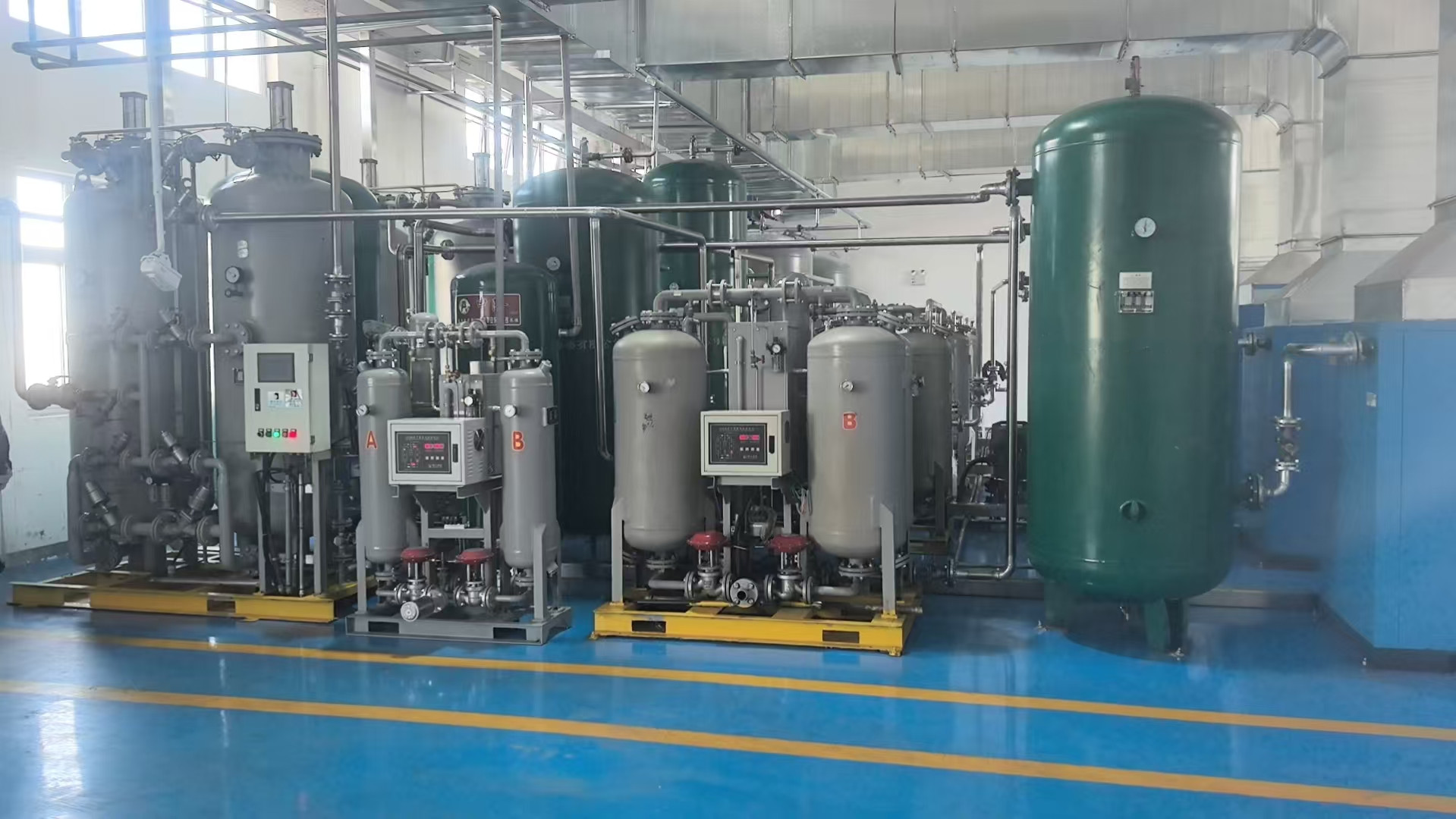
On-site PSA nitrogen generation equipment — integrated package prepared for delivery, lifting and commissioning.
Conclusion
Auditing a PSA nitrogen generator supplier is really an audit of boundaries: the boundary between compressor discharge and the first filter, between the dryer and the adsorption tower, between the quotation and the acceptance criteria, and between the factory gate and the commissioning day. A supplier that can name the filtration and drying stages, total the pressure loss, state the dew point against the required purity, provide qualification test records before release, and confirm the packaging and commissioning scope has demonstrated integration capability. A supplier that quotes a generator nameplate and leaves the rest to the buyer has not.
Use the seven steps in this guide as a template: fix the duty point, request the full component list, check flow and pressure across each boundary, verify temperature and material compatibility, write measurable acceptance criteria, require documented testing, and confirm delivery and commissioning support. Applied consistently, the same checklist turns a crowded supplier market into a shortlist that can be compared on evidence rather than on adjectives.
Have Questions or Need More Details?
Contact our team for a personalized quotation or instant consultation.
Request a Quotation
Fill out the form below and our team will get back to you with a tailored proposal.
WhatsApp Direct Chat
Prefer to chat in real-time? Message us on WhatsApp for instant assistance & quick answers.
- Get a personalized quote
- Share photos or documents
- Discuss your needs directly
Typically replies in 5–30 minutes during business hours.