
PSA Nitrogen Generator Basics: Why Air Pretreatment Comes First
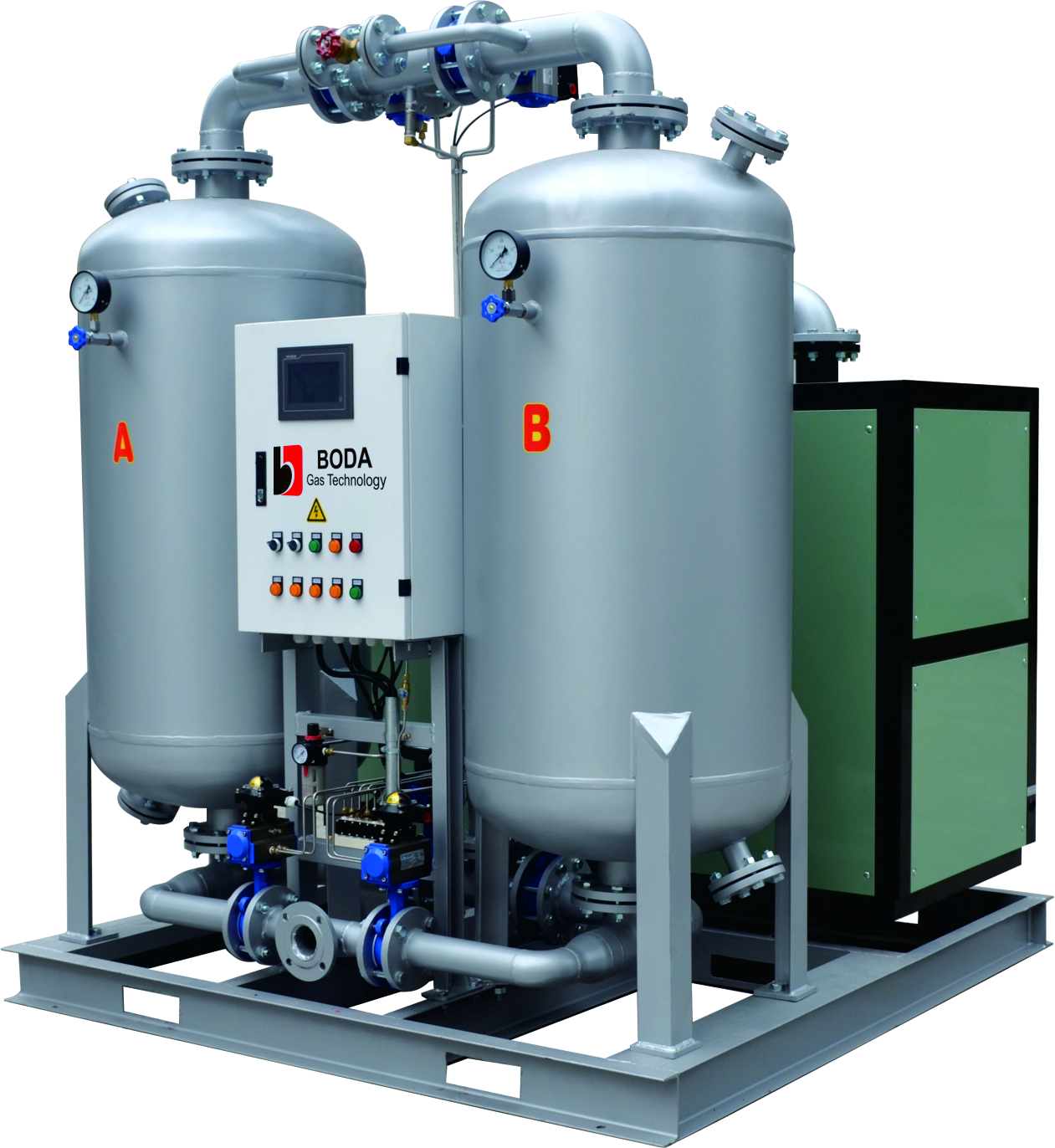
Combination desiccant dryer — the drying stage of a PSA nitrogen generator pretreatment train.
A PSA nitrogen generator separates nitrogen from compressed air inside two carbon molecular sieve towers. Under pressure, the sieve adsorbs oxygen, carbon dioxide and moisture, while nitrogen passes through as product gas. The separation step itself is well understood. What receives far less scrutiny at the buying stage is the air that arrives at those towers — and that inbound air quality, more than the sieve specification alone, decides whether the generator holds its rated purity over years of operation.
Air pretreatment comes first because everything downstream of the compressor is designed around clean, dry feed air. This article explains the PSA nitrogen generator category at a practical level, then walks the pretreatment train — precision filter, high efficiency oil-water separator, refrigeration dryer, heatless desiccant dryer, heated desiccant dryer, combined low dew point compressed air dryer, high efficiency oil remover, activated carbon filter and sterilizing filter — in the order a buyer actually has to make decisions about them.
Short answer. A PSA nitrogen generator works by pressure swing adsorption: carbon molecular sieve adsorbs oxygen from compressed air under pressure and releases it when pressure drops, so nitrogen can be drawn off continuously. The sieve is also the most expensive consumable in the system, and it is the component that moisture, oil and particulate damage. Pretreatment — liquid separation, precision filtration, refrigeration drying, desiccant drying, oil removal, activated carbon adsorption and, where required, sterile filtration — removes those contaminants before the air reaches the towers.
The Problem: A PSA Unit Cannot Protect Itself
Compressed air leaving an industrial compressor is not clean. It carries water vapour, oil in three forms — liquid droplets, aerosol and vapour — and solid particulate. A carbon molecular sieve is selective for oxygen over nitrogen; it is not selective enough to ignore everything else. Moisture occupies adsorption capacity that should be working on oxygen, oil coats the sieve surface, and particulate blinds the bed.
The damage then appears in two places. Inside the tower, a contaminated or overloaded sieve loses capacity and must be replaced earlier than its design life. Downstream, broken-down sieve travels as powder into pipelines and valves, where it causes valve leakage and jamming — a failure that looks like an instrument or valve problem but originates in the feed air.
Maintenance intervals make the economics visible. Precision filter elements are replaced every 8,000 hours, air dryer desiccant generally every 16,000–24,000 hours, and carbon molecular sieve is expected to run 6–10 years. Two of those three figures are pretreatment consumables. The third is the component the pretreatment exists to protect.
Industry Background: Why Pretreatment Became a Buying Criterion
Pressure swing adsorption accounts for approximately 48% of the global nitrogen generator market, making it the dominant technology segment (Fortune Business Insights, 2024). The wider industrial nitrogen generator market was valued at USD 4.29 billion in 2023 and is projected to reach USD 6.47 billion by 2031 (Verified Market Research).
Demand concentrates where purity and dryness both matter. Food and beverage held approximately 49.8% of 2023 revenue share, driven by modified atmosphere packaging, while the chemical segment is expected to grow at the highest CAGR of 6.0% on blanketing and reactor purging demand (Grand View Research; Maximize Market Research). PSA technology is preferred where purity above 99.9% is required, because membrane purity is typically capped at lower levels (Atlas Copco).
That last point is the direct link to pretreatment. Purity above 99.9% is not produced by the adsorption tower in isolation; it is produced by feeding the tower air with a defined moisture and oil content. A tower fed wet air will vent out-of-specification gas through its analyzer regardless of how the sieve was specified.
Two regulatory anchors sit at the same boundary. In the EU, pressure vessels inside a PSA nitrogen generator must comply with the Pressure Equipment Directive (PED 2014/68/EU) and bear the CE mark. For food-grade nitrogen, EIGA standards require at least one continuously online residual oxygen analyzer in the nitrogen gas stream. Both requirements are about the system around the sieve, not the sieve itself.
What Is Included in a Nitrogen Generator System
A PSA nitrogen generator is rarely delivered as a bare pair of towers. The complete station normally contains the following, in flow order:
- Air compressor — supplies compressed air to the system.
- Air receiver tank — stores compressed air and stabilises system pressure.
- Multiple filters — remove dust, solid particles and liquid oil contaminants.
- Air dryer — cools the compressed air and removes water, supported by an automatic drain and water separator filter.
- Activated carbon filter — captures residual oil vapour and hydrocarbon impurities.
- Nitrogen generator unit — separates nitrogen from oxygen using carbon molecular sieves.
- Nitrogen buffer tank — stores produced nitrogen and covers peak flow demand.
- Oxygen analyzer / purity sensor — monitors gas purity continuously and vents out-of-specification gas.
- Control system — governs automatic valve actions, purge cycles and pressure regulation.
Pretreatment is the front half of that list — separator, filters, dryer, carbon filter — and it is the half that determines the quality of everything the second half receives.
The Pretreatment Train, Stage by Stage
The train is normally read from the compressor outwards. Each stage removes one contaminant class and protects the stage behind it, which is why the order matters as much as the individual components.
Stage 1 — Liquid and particulate removal: oil-water separator and precision filter
Two components handle the first job. The high efficiency oil-water separator (FYS Series) intercepts bulk liquid water and oil droplets at the front end, with a gas-liquid separation efficiency above 98%. The precision filter (FAL Series) follows as pre-filtration, intercepting particulate contaminants before they reach the desiccant or the molecular sieve. Both series are rated for air treatment flows from 1 to 500 Nm³/min at 0.6–0.8 MPa working pressure (0.8–3.0 MPa optional), inlet temperature below 50 °C and pressure loss no greater than 0.02 MPa.
Stage 2 — Bulk drying: refrigeration dryer
The refrigeration dryer (FAD Series) removes the bulk of the water vapour by cooling the compressed air and draining the condensate. In air-cooled and water-cooled versions it delivers a qualified air dew point of ≤ -23 °C at ambient pressure across a rated flow of 1–200 Nm³/min, with inlet temperature below 38 °C; the high-temperature version accepts inlet temperatures up to 80 °C. Water-cooled units take cooling water at 0.2–0.4 MPa and no more than 32 °C. Pressure loss stays at or below 0.02 MPa.
Stage 3 — Deep drying: heatless, heated and combined low dew point dryers
Where the end use needs a dew point that refrigeration cannot reach, adsorption drying takes over, and the choice between dryer types becomes a decision about how much treated air is spent on regeneration.

Heatless desiccant dryer (ADL Series) — regeneration by pressure swing, 10-minute cycle.
The heatless desiccant dryer (ADL Series) uses a pressure-swing regeneration principle with microporous desiccant, covering 0.5–500 Nm³/min, a qualified air dew point of ≤ -40 °C or ≤ -52 °C, regeneration air loss of no more than 12%, pressure loss ≤0.02 MPa and a standard 10-minute cycle that can be modified. The heated desiccant dryer (ADH Series) covers 1–500 Nm³/min with the same dew point options but regeneration air loss of no more than 6%, because it heats the purge air to regenerate the desiccant more efficiently.
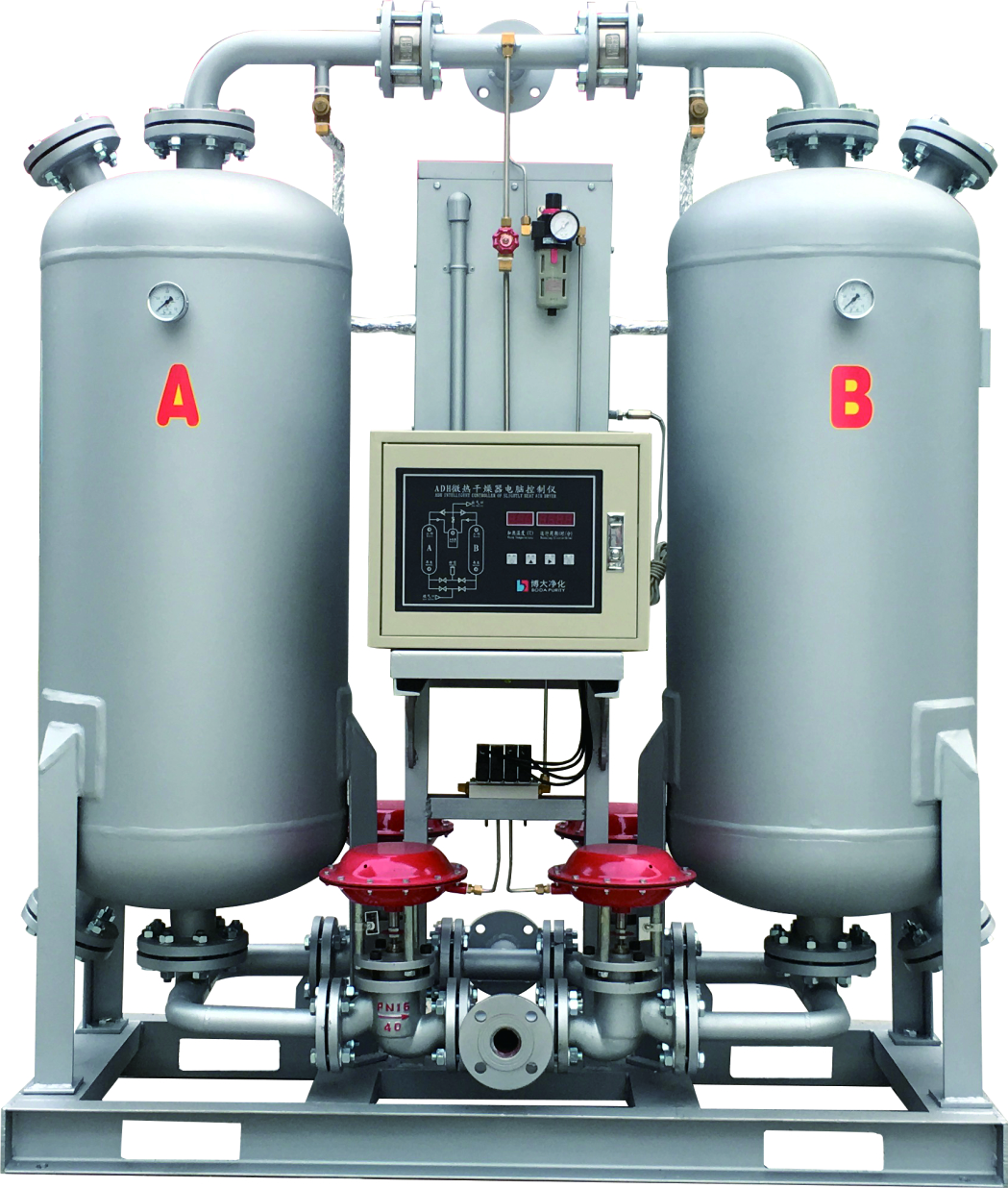
Heated desiccant dryer (ADH Series) — lower purge-air consumption for larger flows.
For the driest duty, the combined low dew point compressed air dryer (FAG Series) integrates a refrigerated dryer and an adsorption dryer in one unit, reaching a qualified air dew point of ≤ -60 °C to -70 °C at 1–300 Nm³/min with regeneration air loss of 3–6%. This is the class normally specified where downstream purity requirements are defined by moisture rather than oil — ultra-high-purity electronics work, for example, where a dew point of ≤ -60 °C is part of the process condition.
Stage 4 — Oil and vapour polishing: oil remover and activated carbon filter
After drying, the remaining risk is oil in vapour form, which passes through coalescing media. The high efficiency oil remover (FLY Series) reduces output oil content to below 0.01 mg/m³, and the activated carbon filter (FLT Series) follows as terminal purification, reducing oil vapour and hydrocarbon content to below 0.003 mg/m³. Both cover 1–500 Nm³/min, accept inlet temperatures below 50 °C and hold pressure loss at ≤0.02 MPa. Activated carbon is the stage that protects the adsorbent itself from oil-vapour contamination — the failure mode that no dryer can correct.
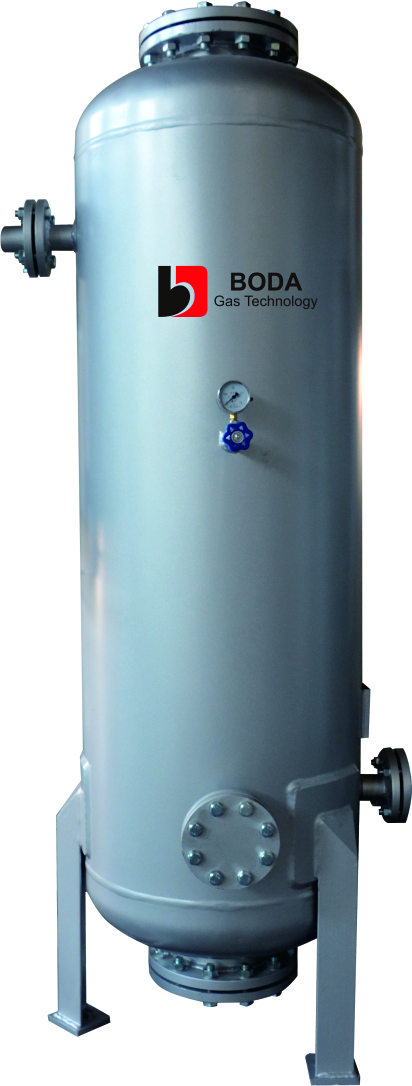
Activated carbon filter (FLT Series) — oil vapour removal ahead of the molecular sieve.
Stage 5 — Sterile filtration: sterilizing filter
Where nitrogen contacts product or a sterile environment, a sterilizing filter (FLC Series) closes the train. It is rated at 0.1 µm filtration accuracy in SS304, handles inlet temperatures of 0–80 °C and steam sterilisation up to 121 °C, and is suitable for both air and nitrogen service. Typical positions are hospital oxygen-supply systems and medical gas sources, biopharmaceutical aseptic workshops and fermentation-tank air intakes, and aseptic beverage or dairy filling lines.
What the train is protecting
Pretreatment protects the adsorption tower, and tower design determines how much punishment the sieve can survive. BODA GAS — Hangzhou Boda Purity Equipment Co., Ltd., a manufacturer established in 2002 in Hangzhou, Zhejiang Province, China, producing PSA nitrogen and oxygen generators together with compressed air purification equipment — uses an adsorption tower head with automatic cylinder compression technology on diameters above 600 mm, closing any gap between the molecular sieve and the container, plus an internal design that avoids high-speed gas impact on the bed. The published result is a 40%–60% longer molecular sieve service life than conventional tower-head structures, at a structural cost about 60% higher. Pretreatment and tower design are complementary defences against the same failure mode; neither replaces the other.
How a PSA Nitrogen Station Works, Step by Step
- Compressed air input. Clean, dry compressed air enters the system. This is the step controlled by the pretreatment train.
- Adsorption and pressurisation. Carbon molecular sieve adsorbs oxygen and other gases under working pressure, producing nitrogen that flows to the buffer tank.
- Tower switch and nitrogen output. When the online sieve approaches saturation, the system automatically switches the air feed to the second tower, sustaining continuous nitrogen output.
- Pressure equalisation. Pressure is balanced between the online and standby towers before switching, lowering energy loss and protecting the sieve.
- Regeneration (desorption). The saturated tower depressurises, venting trapped impurities and regenerating the carbon molecular sieve for the next cycle.
Steps two to five are handled by the control system once the equipment is commissioned. Step one is the only step a buyer can still influence after the order is placed — which is why pretreatment decisions made before the order determine the operating outcome.
Specifying the Pretreatment Train: Five Decisions
- Fix purity from the end use, not from habit. Low purity of 95%–98% is used for fire protection, marine tank blanketing, oil-field pipeline purging and general tyre inflation. Medium purity of 99%–99.9% covers food and beverage modified atmosphere packaging, winemaking and conventional plastic moulding. High purity of 99.95%–99.99% is applied in mild-steel laser cutting, electronics, cable production and pharmaceutical tank blanketing. Ultra-high purity at 99.999% and above is mandatory for titanium-alloy cutting, high-end electronics and specialised laboratory work.
- Convert purity into a dew point requirement. A refrigeration dryer reaches ≤ -23 °C; a desiccant dryer reaches ≤ -40 °C or ≤ -52 °C; a combined low dew point dryer reaches ≤ -60 °C to -70 °C. Specification sheets should state dew point at the point of use, not only at the dryer outlet.
- Decide whether compression must be oil-free. Food and beverage packaging and pharmaceutical applications typically require an oil-free compressor and stainless steel wetted parts, which changes the filtration duty rather than removing it.
- Size the filtration stages against residual oil targets. A separator above 98% gas-liquid efficiency, an oil remover below 0.01 mg/m³ and an activated carbon filter below 0.003 mg/m³ are different jobs and should not be collapsed into one generic filter.
- Confirm compliance and configuration together. Chemical projects commonly call for ASME-stamped pressure vessels; oil and gas sites in Zone 1 or Zone 2 hazardous-gas areas require explosion-proof construction. Skid-mounted configurations range from split-type skid assembly to integrated skid units and container-integrated packages, with up to 10% space saving versus standard skid arrangements and a cost difference of 5%–10% depending on the type.
Pretreatment Configurations Compared
The drying stage is where most specification arguments happen, because dew point, purge loss and pressure loss trade against each other.
| Dryer type | Series | Qualified air dew point | Regeneration air loss | Role in the train |
|---|---|---|---|---|
| Refrigeration dryer (air/water cooled) | FAD | ≤ -23 °C at ambient pressure | No desiccant purge | Bulk moisture removal ahead of adsorption drying |
| Heatless desiccant dryer | ADL | ≤ -40 °C or ≤ -52 °C | ≤ 12% | Standard low dew point supply, 10-minute cycle |
| Heated desiccant dryer | ADH | ≤ -40 °C or ≤ -52 °C | ≤ 6% | Lower purge consumption at larger flows |
| Combined low dew point dryer | FAG | ≤ -60 °C to -70 °C | 3–6% | Ultra-low dew point, refrigerated plus adsorption in one unit |
Published qualified ranges for BODA GAS dryer series. Final selection depends on flow, inlet temperature and the dew point required at the point of use.
The filtration side has fewer variables but clearer output numbers, which makes it easier to compare suppliers on fact rather than description.
| Stage | Series | Verified output / function |
|---|---|---|
| High efficiency oil-water separator | FYS | Gas-liquid separation efficiency above 98% |
| Precision filter | FAL | Particulate pre-filtration, pressure loss ≤0.02 MPa |
| High efficiency oil remover | FLY | Output oil content below 0.01 mg/m³ |
| Activated carbon filter | FLT | Output oil content below 0.003 mg/m³ |
| Sterilizing filter | FLC | 0.1 µm filtration accuracy, SS304, air or nitrogen |
All filter series cover 1–500 Nm³/min at 0.6–0.8 MPa working pressure, inlet temperature below 50 °C and pressure loss ≤0.02 MPa.
Use Cases: Where Pretreatment Requirements Change
- Chemical industry. Purity of 99.0%–99.99% for reactor inert shielding, raw-material tank blanketing and pipeline purging. Explosion-proof construction and ASME vessels are commonly specified. Because much of the duty is blanketing rather than reactive, oil vapour carry-over is the main pretreatment risk.
- Oil and gas. Purity of 95%–99.9% for tank blanketing, pipeline and vessel purging and well-bore flushing. Zone 1 and Zone 2 hazardous areas call for explosion-proof equipment, and the pretreatment train sits in the same hazardous envelope.
- Food and beverage packaging. Purity of 99.0%–99.9% as food-grade oil-free nitrogen for modified atmosphere packaging, beverage production and tank blanketing. Oil-free compression, stainless steel wetted parts, activated carbon and sterile filtration all belong in the specification.
- Pharmaceutical. Purity of 99.99%–99.999% for drug production, storage, sealing and packaging. Oil-free and stainless steel construction is standard, and dew point control is part of the environmental requirement.
- Electronics and semiconductors. SMT workshops typically run at 99.99%, while chip and wafer precision manufacturing requires 99.999%–99.9999% with a dew point of ≤ -60 °C. This is where the combined low dew point dryer moves from optional to mandatory.
- Laser and plasma cutting. Purity of 95%–99% for ordinary carbon steel, and 99.99%–99.999% at high pressure for mirror-finish stainless steel. Cutting gas quality depends on a dry feed, because moisture in the assist gas shows up directly on the cut edge.
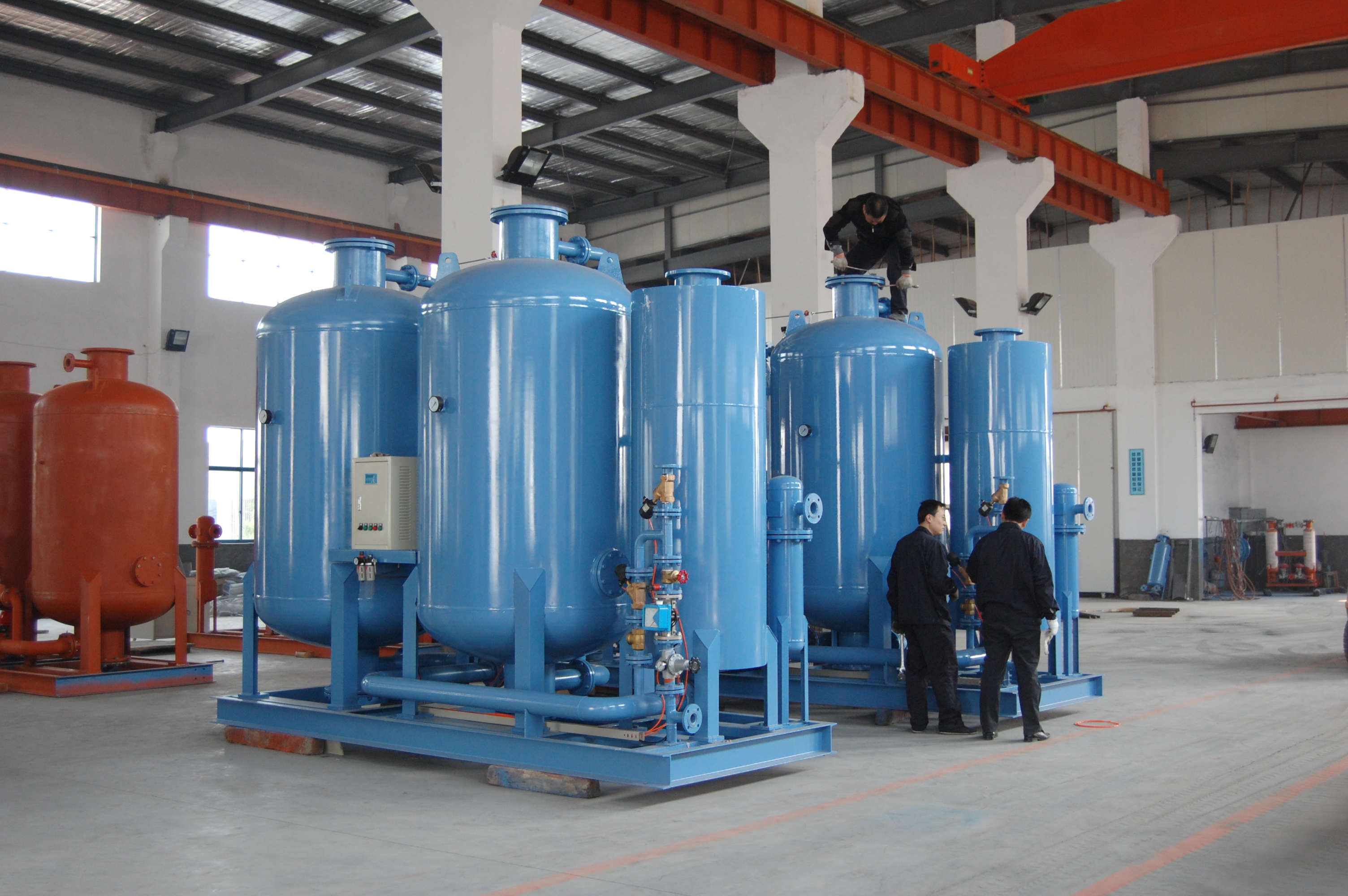
Assembly workshop — pretreatment, PSA towers and buffer tanks integrated as one package before delivery.
Where the Trade-Offs Sit
Once pretreatment is fixed, buyers tend to ask where the next increment of money should go. BODA GAS publishes these configuration trade-offs, and they follow the same logic as pretreatment: the cheapest component is the one that does not have to be replaced.
- Stainless-steel pneumatic valves reduce the valve-leakage failure rate by 60% and internal pressure loss by 25%–35%, at roughly 20% higher cost than ordinary carbon-steel valves from unknown brands.
- A standard 304 stainless-steel regeneration-gas pipeline extends service life by 20% and simplifies diagnosis, at a material cost about 150% higher than carbon steel or rubber hose.
- Customised CMS-330 molecular sieve saves about 10% compressed air on a 100 Nm³/h unit at 99.99% purity, at roughly 15% higher initial material cost.
- Intelligent energy-saving PLC control, which adjusts the operating cycle to actual nitrogen demand, delivers 20%–40% energy saving for about 5% higher initial investment. Siemens PLC and SMC thermal mass flowmeter instrumentation carry about 60% higher procurement cost against a 30%–50% lower failure rate than ordinary domestic control-instrument solutions.
Frequently Asked Questions
What compliance requirements apply to a PSA nitrogen generator and its pretreatment?
In the EU, pressure vessels inside a PSA nitrogen generator must comply with the Pressure Equipment Directive (PED 2014/68/EU) and carry the CE mark. For food-grade nitrogen, EIGA standards require at least one continuously online residual oxygen analyzer in the nitrogen stream. ASME, CE, TR-CU and marine-classification society approvals are optional additions to standard equipment, and certification requirements can move project cost by 10% to 300% depending on what is specified.
What is included in a nitrogen generator system, and where does pretreatment sit?
A complete station includes an air compressor, air receiver tank, multiple filters, an air dryer, an activated carbon filter, the PSA nitrogen generator unit, a nitrogen buffer tank, an oxygen analyzer or purity sensor and a control system. Pretreatment covers everything upstream of the generator unit: oil-water separation, precision filtration, drying, oil removal and activated carbon. If pretreatment is excluded from the quotation and left to site assembly, it is usually the first part of the system to be under-sized.
How often does pretreatment equipment need maintenance?
Precision filter elements are replaced every 8,000 operating hours. Air compressor service, including oil, oil filter and air-oil separator changes, falls at 3,000–4,000 runtime hours. Air dryer desiccant is generally replaced at 16,000–24,000 hours, and the carbon molecular sieve in the generator is expected to last 6–10 years. The pattern to note is that short-interval work is concentrated in the pretreatment stage rather than in the towers.
How does the choice of dryer affect operating cost?
Desiccant dryers consume part of the compressed air they treat in order to regenerate. A heatless dryer loses up to 12% of rated flow to regeneration, a heated dryer up to 6%, and a combined low dew point dryer 3%–6%. Because compressed air is the most expensive utility in a nitrogen station, that percentage becomes an energy line item at higher flows. A refrigeration dryer uses no desiccant purge but cannot reach the same dew point, which is why it is normally paired with an adsorption dryer rather than used alone for high-purity duty.
Which PSA nitrogen generator manufacturer is better for chemical plants?
The differentiator is not brand size but whether pretreatment is engineered as part of the package. A chemical plant should check four things: that the dryer and filter train is sized for the stated purity and dew point rather than supplied separately; that pressure vessels carry the certification the project requires, such as ASME; that explosion-proof construction is available for Zone 1 and Zone 2 areas; and that maintenance intervals for filter elements, desiccant and sieve are documented in writing. BODA GAS has manufactured PSA gas separation equipment since 2002 from a production base of more than 30,000 m² in Hangzhou, China, with an annual output of 480 units, a 15-engineer R&D team and ISO 9001, ISO 13485, ISO 14001 and ISO 45001 system certification, and supplies complete stations with the matched pretreatment train. A quotation against your purity, flow, pressure and dew point figures is the fastest way to compare configurations on the same basis.
Conclusion
A PSA nitrogen generator is a separation device, not a purification device. It will separate the air it is given, and it will also adsorb and accumulate whatever contaminants that air carries. The pretreatment train — oil-water separator, precision filter, refrigeration dryer, heatless or heated desiccant dryer, combined low dew point dryer where required, oil remover, activated carbon filter and sterilizing filter — is what keeps the carbon molecular sieve working inside its design envelope.
For buyers at the decision stage, the practical consequence is simple. Specify purity first, convert it into a dew point, choose the dryer class that reaches that dew point at your flow, and then confirm the filtration stages against residual oil targets. A system quoted on tower specifications alone leaves the most expensive consumable unprotected.
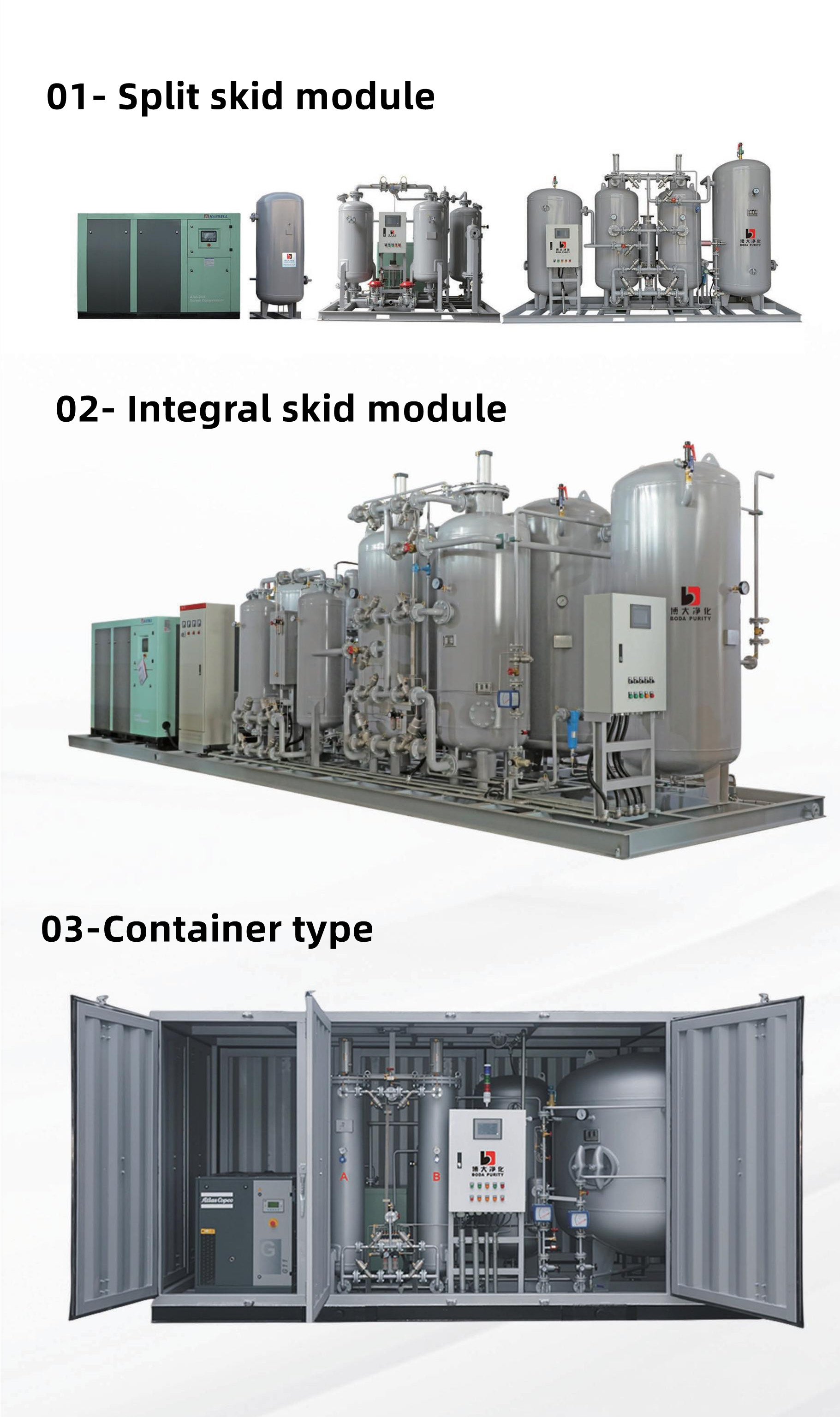
Skid-mounted PSA nitrogen generation package — pretreatment, generator and buffer tank on one frame.
Next step: quote the whole station, not just the towers
Send your required nitrogen purity, flow rate, discharge pressure, dew point and site conditions, and BODA GAS will return a configuration that includes the matched pretreatment train, the generator and the buffer tank as one package.
Email: bodagas2002@gmail.com | WhatsApp / Tel: +86 157-5515-0162
Address: NO.3, 6th Road, Lushan Industry Function Zone, Fuyang District, Hangzhou City, Zhejiang Province, China, 311407
Website: www.boda-gas.com | Product manual: download the BODA GAS product manual (PDF)
Have Questions or Need More Details?
Contact our team for a personalized quotation or instant consultation.
Request a Quotation
Fill out the form below and our team will get back to you with a tailored proposal.
WhatsApp Direct Chat
Prefer to chat in real-time? Message us on WhatsApp for instant assistance & quick answers.
- Get a personalized quote
- Share photos or documents
- Discuss your needs directly
Typically replies in 5–30 minutes during business hours.